Something I Learned Today: Drones, Diesel, and Don Jr.’s Russian Bankroller

Just as Ukraine was learning how to parry Russia’s drone attacks, Moscow has moved the goal posts with a new generation of innovative jet-powered weapons.

New Geran drones and Banderol cruise missiles are lethal reminders that Russia still has the resources and supply chains to field fresh threats, this time packed with advanced electronics that allow them to find targets accurately and evade interception. Crucially, the leap forward was enabled in large part by components sourced from China, in violation of international sanctions, say Ukraine and others, based in part on wreckage from the few shot down so far.

China has said it regulates exports of technologies that could be used in war. 

Russia’s new and relatively inexpensive weapons show its military remains adaptable and innovative, say analysts and diplomats. Russia developed and fielded both weapons within a couple of years by modifying earlier models, combat-testing them and quickly starting mass production, say analysts.

In doing that, Moscow stole a march on its adversaries. Ukraine has shown it can move quickly—it developed one of the first effective jet drones—but lacks production resources and much capacity to think beyond the near future. 

The U.S. and its allies in the North Atlantic Treaty Organization, meanwhile, are struggling to increase production of vital arms such as Patriot interceptors. Western governments are also grappling with how to accelerate turning innovations into mass-produced equipment.

“Here in the West, we tend to underestimate Russia, but they can go very fast from idea and experimentation to production,” said Kateryna Bondar, a senior fellow at the Center for Strategic and International Studies’ Wadhwani AI Center in Washington. “This loop is something Western militaries should learn from Russia.”

Russia has largely directed its weapons at Ukraine, part of a campaign against civilian life and infrastructure. Some Russian drones and missiles have also entered NATO airspace, either accidentally due to electronic warfare or intentionally in an attempt to probe NATO defenses. Either way, say military analysts, NATO must learn from—and be ready for—Russia’s ability to unleash a range of aerial weapons at different altitudes, speeds and cost levels.

Moscow’s developments also directly affect the U.S. because Russia, Iran and North Korea share military know-how. Innovations from the war in Ukraine are appearing in America’s war with Iran and vice versa.

Moscow has managed to field its new weapons despite Ukraine’s increasingly damaging strikes on critical nodes in Russia’s economy. President Vladimir Putin has used his iron grip on the country to largely reorient it behind his conquest of Ukraine, allowing him to funnel cash from the budget and state-owned banks into the defense sector. He has mobilized in a way that NATO’s democracies haven’t considered doing since World War II.

Banderol and Geran both address a need for cheap yet capable one-way weapons—an economic middle ground that Ukraine and Western countries are also pursuing. The new weapons are a mix of upgraded low-end arms and simplified high-end ones. They each represent a different mix of cost, range, speed, explosive power and ability to reach a target without interception.

Banderol and Geran-5 are both estimated to cost around $100,000 each. High-end U.S. Tomahawk cruise missiles and comparable Russian models cost more than $2 million each.

Geran drones began as versions of relatively slow, propeller-driven Iranian Shahed drones, which Ukraine has become adept at intercepting after heavy investment in equipment and training to counter the threat. Russian engineers, through successive iterations, added speed and survivability thanks to better electronics for navigation and communications, overcoming much of Ukraine’s defenses.

DroneSec analysts concur with Ukrainian assessments that Russia relies heavily on Chinese components including jet engines, navigation computers and communications electronics.

“Russia is critically dependent on Chinese components” for its drone program, said Monnik.

Most of the Chinese gear is commercially available, so-called dual-use components made for civilian or military applications, say analysts. Russian engineers are skilled at exploiting off-the-shelf equipment to maximum benefit, such as in creating antennas that thwart electronic countermeasures and communication networks that overcome jamming. 

Once designs are adopted, Russian companies quickly move to large-scale production, which fulfills another strategic goal of all sides today: volume. Since the Cold War, the U.S. and its rivals have largely pursued expensive, exquisite weapons systems, which proved effective in limited conflicts.

“Now we see that mass is a huge part of success,” said Bondar.

For Ukraine, Moscow’s advances are confounding because it also faces Russian ballistic missiles, which carry massive explosive payloads and are especially difficult to intercept. Russia is also pummeling Ukrainian troops with glide bombs dropped from warplanes, which Ukraine has almost no way to stop. The pounding threatens Kyiv’s ability to maintain its front lines.

“While the drones are a problem, by far the biggest problem for Ukraine is glide bombs,” said Justin Bronk, a research fellow at the Royal United Services Institute, a British think tank.

For the U.S. and its allies, Russia’s improved drones create an economic headache. American forces in the Persian Gulf and NATO have resorted to using expensive equipment like Patriots and jet fighters to intercept inexpensive drones and missiles. Kyiv and Western governments are seeking cheaper ways to thwart low-cost attacks.

Western military-tech companies that have been developing interceptors for propeller drones are scrambling to create faster models. Merops interceptors, produced by a company backed by former Google CEO Eric Schmidt and deployed by U.S. forces both along NATO’s eastern flank and in the Persian Gulf, are now being redesigned in a jet-powered version. Auterion, a leading software supplier to Ukrainian drone makers, is working with partners on high-speed propeller interceptors and jet-powered ones, said CEO Lorenz Meier.

Sourcing inexpensive jet engines for interceptors is a big challenge for the West. Chinese jet engines for Gerans cost $45,000 or less, DroneSec estimates, and defenders generally fire several interceptors at each incoming weapon.

Blurred lines among classes of weapons call for defenses that are more integrated and prepared for a spectrum of threats aiming to overwhelm air defenses, say military specialists. Bronk said NATO would be well served to set up a specialized multinational counterdrone force that constantly trains to down all kinds of drones and missiles. He said this could be done using relatively affordable equipment like radar-guided antiaircraft cannons and simple jet planes used to train combat pilots.

“It’s not an inherently difficult problem,” said Bronk. “It’s just not one we’re optimized for.”

U.S. and NATO officials say they are tackling the problem.

“We must apply and adapt all available tools and capabilities to the realities we face today,” said Army Col. Martin O’Donnell, spokesman for NATO’s top military commander, Air Force Gen. Alexus Grynkewich. He said that NATO members at their recent summit pledged to invest more than $40 billion over five years in counterdrone capabilities.

Anticipating future development waves will be critical, said Bondar. She noted that Ukraine has had indications for several years that Russia was working on jet-powered drones and inexpensive cruise missiles, yet Kyiv has been unprepared for their large-scale use.

“It was obvious quite a while ago that we’d end up here,” said Bondar. “I’m surprised everyone is surprised.”

Source: Daniel Michaels, “Russia Is Churning Out Smart, Cheap New Weapons Faster Than Ukraine or the U.S.,” Wall Street Journal, 13 September 2026. I am paid subscriber to the digital edition of this newspaper, and so I am happy to share articles like this with my own readers. }}}}} trr


As wars in the Middle East and Ukraine drive the price of diesel to record highs, inflation-weary consumers can expect to pay more for practically everything.

As of Friday, the average retail price of diesel fuel stood at $6.06 per gallon, according to AAA, up from $3.71 a year ago.

The New England average price is virtually identical to the national average, but far lower than that in California, which at $7.98 is the highest in the nation.

“It makes us a lot more expensive than we used to be,” said Charlie Itz, president of Itz-Ohlson Transport, a trucking company in Lynnfield.

It’s happening because, even though the US is the world’s leading producer of diesel, much of the nation’s production is exported to countries that can no longer obtain fuel from refineries in the Middle East or Russia due to military conflicts.

“The United States is experiencing this because it’s part of a global, interconnected market,” said Mason Hamilton, vice president of economics and research at the American Petroleum Institute, or API.

The pervasive effects from those higher prices shows up across the economy. On Friday the US Bureau of Labor Statistics reported that inflation for August ran at a 3.4 percent annual clip, with gas and fuel oil major culprits in keeping consumer prices elevated.

Consumers usually pay closer attention to gasoline prices, which climbed 3.9 percent last month according to Friday’s inflation report.But diesel is just as vital to the US economy, because it’s the primary fuel for the large trucks and freight trains that deliver most of the nation’s goods. Diesel also powers many seagoing ships. Higher diesel pricesmean we pay more for products shipped to homes and retail stores.

Moreover, the price of diesel has climbed much faster than that of gasoline, which is up by about $1 a gallon from last year. That’s largely because many US refineries are optimized to produce gasoline, helping to keep prices in check.

It all means higher fuel prices for truckers such as the independent contractors who drive for Itz-Ohlson Transport.

The company mostly handles short-range jobs, like moving shipping containers in and out of the Port of Boston. The company charges a base rate of $401 for trips within 30 miles of the port, then adds a surcharge to cover the cost of diesel. In March, the surcharge stood at 38 percent of the base rate, or $152. Now it’s up to 57 percent, or $228.

“Our customers are pretty understanding,” said Itz. “I think they’re resigned.”

Costly diesel is bad news for James Knott, chief executive of Riverdale Mills, a Northbridge-based maker of steel wire mesh used in products ranging from fences to lobster traps.

“High diesel costs affect us at virtually every stage of the supply chain,” said Knott. The company uses steel from US and Canadian suppliers, then ships its wire mesh to customers throughout the US and around the world.

When diesel gets more expensive, “those costs do not simply disappear,” Knott said. “Manufacturers must absorb them, find efficiencies elsewhere, or eventually pass some portion along to customers.”

Dean Croke, principal industry analyst at DAT Freight & Analytics, an online marketplace for truckers and shippers, said the impact of higher diesel may depend on the value of the goods being shipped. For instance, if a company is shipping costly computers, a price increase to cover fuel is hardly worth noticing. “A few hundred dollars of fuel,” said Croke, “is like a rounding error.”

But it’s a different story with lower-cost products shipped over long distances, he said. Consumers can expect to pay a significant fuel premium for iceberg lettuce shipped from California, for instance.

While the nominal price is the highest on record, diesel is still going for well below the all-time high reached during the 2008 financial crisis, which after adjusting for inflation to today’s dollars, topped out at $7.20, according to the US Energy Information Administration.

The diesel price hikes have arrived just as the US trucking industry had begun to recover from a four-year slump. A spike in demand that began during the COVID pandemic put hundreds of thousands of new drivers on the roads. But demand fell again, pushing down the price of truck deliveries and driving many small- and medium-sized truckers out of business.

Croke said the slump would be even worse if not for the recent surge in construction of data centers to support artificial intelligence systems.These huge buildings require thousands of truckloads of construction materials and electronic gear.

“Absent that,” said Croke, “demand would be way down.”

But the trucking market has begun to recover, as a shortage of workers means fewer trucks on the road. One major reason: the Trump administration’s crackdown on noncitizen drivers, who now must have visas that allow them to workand prove they speak English well enough to drive safely on US highways. The Department of Transportation estimates that enforcing those standards will force 200,000 drivers off the roads. That’s around 9 percent of the 2.2 million tractor-trailer drivers in the US workforce, according to the Bureau of Labor Statistics.

“We’re seeing the largest single-driver-removal event in modern history,” said Croke.

As a result, spot rates for shipping a truckload of merchandise have hit their highest levels in four years. And now, the cost of diesel is driving prices even higher.

The increase stems from tight supplies worldwide. The 2022 diesel price spike was driven by a halt in US purchases of diesel fuel from Russia. The European Union followed suit. But Russia was still able to sell its oil in other countries including Turkey and Brazil.

In all, Russia once exported over 800,000 barrels of diesel per day, making it the world’s second-largest exporter after the United States, which increased shipments to the EU to cover for lost Russian oil.

But this year Ukrainian airstrikes against Russian refineries have forced Russia to halt virtually all diesel exports. That means a big decline in worldwide diesel production, and upward pressure on prices.

The battle over the Strait of Hormuz has also had an impact. A Goldman Sachs analyst recently estimated that despite US government efforts to keep the strait open, shipments of refined oil products like gasoline and diesel are only at 35 percent of their prewar levels.

And then in March, China, a major exporter of diesel to Asian markets, halted all foreign sales to protect its domestic supply, though the Chinese government this summer allowed some exports to resume.

The US produces over 5 million barrels a day of distillate fuel oil, which includes diesel and home heating oil. That’s more than any other nation.

But there’s no way to open the tap any wider. “Basically every single refinery in the United States right now is running full out,” said Hamilton of API.

And much of their output is exported to Europe and Latin America. The US imports millions of barrels as well, with, ironically, much of New England’s diesel coming from Canada, with whom President Trump has just started a massive trade war. So far, diesel has not been caught up in the tit-for-tat retaliations by either country.

In short, the market for diesel is global and supply shortfalls anywhere lead to high prices everywhere, even in New England.

Source: Hiawatha Bray, “Diesel prices soar past $6 a gallon, affecting the cost of nearly everything else,” Boston Globe, 11 September 2026. I am paid subscriber to the digital edition of this newspaper, and so I am happy to share articles like this with my own readers. }}}}} trr


U.S. President Donald Trump on Sunday called on Ukrainian President Volodymyr Zelenskyy to halt strikes on Russian oil refineries and other infrastructure used to produce and distribute diesel, saying the attacks are causing a global shortage. He spoke after diesel prices in the U.S. hit a record on Friday, soaring past $6 a gallon on average.

Ukraine has for months been targeting Russia’s oil and gas industry with long-range strikes, prompting fuel rationing across the country and causing Moscow to ban diesel exports in July, removing supplies from the already tight global market.

But the global crunch also came after the war on Iran curtailed oil shipments through the Strait of Hormuz.

Fuel prices are weighing on Americans as they prepare to vote in midterm elections in November.

Trump was asked by a reporter if he had spoken with Zelenskyy following his recent conversation with Russia’s Vladimir Putin. He responded by calling on Zelenskyy to halt strikes against Russia.

“Mr. Zelenskyy has to do one thing. He has to stop knocking out diesel fuel in Russia,” Trump told reporters on the sidelines of the Irish Open, which is being played at his Doonbeg golf club.

“We spoke to Mr. Zelenskyy about it. There are plenty of other targets. Don’t hit diesel fuel, because that’s hurting, that’s hurting the world,” he said.

According to a report published Friday by the International Energy Agency, net exports of diesel and gasoil from the Gulf countries in August stood at “just over a quarter” of what they were before the war on Iran began in February.

“Disruptions to Russia’s refining system and a near-halt to product exports following intensified Ukrainian attacks have compounded these losses,” the IEA wrote. It added that in February, combined next exports of diesel and gasoil from the Gulf and Russia “accounted for almost 45% of global seaborne trade.”

Kyiv says Russia’s oil industry both funds and directly fuels Moscow’s more than four-year-old invasion of Ukraine.

Russia has ramped up its air campaign against Ukraine in recent weeks, using ballistic missiles and jet-powered drones to pierce Ukraine’s defenses. Moscow’s attacks have targeted Ukraine’s power grid ahead of winter in what officials say is meant to demoralize civilians.

Civilians were killed and injured overnight into Sunday as Russia and Ukraine exchanged large-scale drone strikes.

Two people were killed and 14 more wounded near an oil and industrial hub in Russia’s Tatarstan, according to local officials, while Ukrainian authorities reported on Russian drones pummeling the Black Sea port of Odesa and starting a fire near a border crossing with Poland.

The two Russian civilians died after a drone slammed into a tree near their parked car in the city of Nizhnekamsk, according to the office of regional head Rustam Minnikhanov. Nizhnekamsk houses a key cluster of oil refineries and other industrial plants. Mayor Radmir Belyaev said that a fire had broken out at an unspecified “enterprise.”

Ukraine also claimed to have hit a major oil refinery in Slavyansk-on-Kuban, in Russia’s Krasnodar region near Crimea. The Defense Intelligence of Ukraine (DIU) agency said its drones struck a key oil processing unit and the refinery’s tank farm overnight into Sunday.

Krasnodar authorities said the strike on “an enterprise” in Slavyansk-on-Kuban injured three people and damaged an oil pipeline.

Russian forces shot down 389 Ukrainian drones during the night, Russia’s defense ministry said Sunday.

In Ukraine, at least nine people were injured in a “massive” Russian nighttime attack on Odesa, according to Serhii Lysak from the city’s military administration. Odesa is home to Ukraine’s main port hub on the Black Sea and has faced sustained drone and missile strikes, with Kyiv accusing Moscow of trying to choke off its exports.

A Russian drone attack on Saturday struck a residential high-rise in Odesa, killing two people and injuring 26 others, Ukrainian officials said.

Russian overnight strikes also pounded western Ukraine, though there were no immediate reports of casualties. One drone set fire to a gas station near the Yahodyn-Dorohusk border crossing with Poland, according to Ukraine’s top diplomat and a spokesperson for the local customs force.

“This is Putin’s terror ‘knocking’ directly on the doors of the EU and NATO. Russian barbarians are at your gate, dear partners,” Ukrainian Foreign Minister Andrii Sybiha wrote on X.

Ukraine’s border crossings with Poland are a conduit for much of the military and humanitarian aid sent by Western allies.

Valentyna Chernysh, a spokesperson for the Volyn Customs Office, told The Associated Press that the Yahodyn crossing was intact and no one was harmed.

Earlier this week, two people died when Russian drones hit the Starokozache border crossing between Ukraine and Moldova on Tuesday. The following day a “direct threat” to a Polish-Ukrainian crossing point was avoided due to the cooperation between Warsaw and Kyiv, according to Polish Prime Minister Donald Tusk.

Ukraine’s air force said its air defenses shot down or suppressed 409 Russian drones of various types overnight, including a newer jet-powered version that is faster and more difficult to intercept. It said Russia had attacked Ukraine with 453 drones in total.

Source: “Trump calls on Ukraine to halt strikes on Russian diesel fuel, citing a global shortage,” Associated Press (via ABC News), 13 September 2026


On May 24, Donald Trump Jr. was celebrating in the Bahamas, as scantily clad dancers in stilettos and sailor caps performed for him and his guests. It was the last night of his wedding, a lavish, three-day party held across a pair of ultra-exclusive private islands. A five-tier funfetti cake had been airlifted in from Florida, and helicopters and seaplanes descended on the islands before guests settled into their oceanfront villas. That night on the beach, Trump Jr. lifted his bride into the air while fireworks launched from a barge over the sea.

“It was everything we dreamed of and more,” his wife later wrote on Instagram.

That dream was heavily funded by a secret benefactor: Umar Kremlev, a Russian oligarch close to President Vladimir Putin.

Kremlev footed the bill for hundreds of thousands of dollars of wedding expenses, according to records reviewed by ProPublica and interviews with three people familiar with the event. The oligarch paid to rent out one of the private islands, where a reception was held and where guests slept. He also covered other big-ticket items, like the fireworks show, and his team helped plan the event. Kremlev is the head of the International Boxing Association, a scandal-plagued sports group that has been financed by the Russian state-owned energy giant Gazprom. The wedding payments came from an IBA-affiliated entity in Dubai that the boxing association uses for financial transactions.

The guest list numbered around 50. It included Trump Jr.’s brother-in-law Jared Kushner, Eric Trump — and Kremlev, an imposing man with a shaved head who speaks limited English. The oligarch was part of a large group whose presence puzzled other attendees. They sometimes stood off by themselves, speaking Russian.

“It was really small, like, just really close friends,” Trump Jr. later said on his podcast. “Tried to keep it really tight. And it was just awesome.”

Kremlev’s previously unreported relationship with Trump Jr. represents an extraordinary development: a member of Putin’s circle financially supporting the president’s son and gaining intimate access to the Trump family. For a decade, Putin’s government, regarded as a chief adversary of the U.S., has been accused of efforts to influence American elections. Attempts by Russia to make inroads with the Trumps before the 2016 election exploded into controversy that dogged much of the president’s first term.

National security experts expressed alarm at Trump Jr. accepting the oligarch’s largesse, saying it raised an urgent question: What motivated Kremlev to spend a fortune cultivating the connection? 

“If I’m paying for your wedding, at some point, you’re going to owe me something,” said Frank Montoya Jr., a retired career FBI official who held senior counterintelligence roles. Oligarchs like Kremlev often act in coordination with the Russian government. While it’s unclear if that happened here, Trump Jr. put himself in a precarious position, Montoya said. “This should be unthinkable for the son of the president. End of story.”

Holden Triplett, who served as Trump’s counterintelligence director on the National Security Council during his first term, said Russian intelligence frequently seeks to build ties with U.S. government officials and their family members. “Money is a tried-and-true method to gain access,” said Triplett, who also worked for the FBI in Moscow.

In the days leading up to Trump Jr.’s wedding, Kremlev was in China as part of the delegation accompanying Putin, according to Chinese state media. The month before, Putin had bestowed him with a state honor, the Order of Friendship. The Ukrainian government has imposed sanctions on Kremlev personally, citing his closeness to Putin and Russian security services.

It’s not clear why Kremlev helped pay for Trump Jr.’s wedding. The men appear to have met only recently. Public reporting suggests Trump Jr. could have afforded it himself, with Forbes recently estimating his net worth at roughly $300 million. 

In response to detailed questions, a spokesperson for Trump Jr. did not dispute the wedding payments from Kremlev. “Umar is a personal friend of Don,” he said. The spokesman said that Kremlev is “not someone he has a business relationship with” and that the men met through a mutual friend in the hunting world and bonded over their love of boxing and the outdoors.

A spokesperson for Trump Jr.’s brother Eric said of Kremlev: “Eric has absolutely no clue who this person is, nor has never heard his name.” 

In a statement, Kremlev’s press office said, “Mr. Kremlev and Mr. Trump Jr have a friendly relationship” and they first met “a couple of years ago.”

The press office described Kremlev as a businessman and philanthropist, adding, “Mr. Kremlev has never discussed political matters with any of his American friends and acquaintances,” including Trump Jr. They said the boxing organization itself did not incur expenses for the wedding but did not comment on the payments from the Dubai entity. The press office also said that when Putin and Kremlev were in China recently, Kremlev was not part of Putin’s “official delegation.”

Kushner, who has been helping lead the U.S. government’s negotiations with Russia over Ukraine, did not respond to requests for comment. The White House and the Russian government did not respond either.

The revelations come as Trump Jr. has emerged as a political power center in his own right. Beloved by the MAGA base, he reportedly played an active role in vetting White House cabinet picks for Trump’s second term and was dubbed his father’s “most essential political adviser” by The Wall Street Journal. “I certainly don’t think I’d be sitting here as the VP nominee without Don’s help,” Vice President JD Vance told the outlet in late 2024.

This account is based on records and interviews with dozens of current and former IBA officials and contractors, wedding attendees and other people in Trump Jr.’s and Kremlev’s circles.

Trump Jr. exchanged vows with socialite Bettina Anderson on a private island that was featured in “Pirates of the Caribbean” and the 2006 James Bond movie “Casino Royale.” They had their first dance on a second private island nearby that can rent for around $100,000 a night, paid for by Kremlev. The company that put on the fireworks display charges around $70,000 for such shows. (Kremlev did not attend the ceremony itself, which was held on the first day and had just 18 guests, Trump Jr.’s spokesperson said.)

The atmosphere was Monte Carlo meets frat party — helicopters in and out, a beachside DJ set, beer pong tournaments. One day, the men went spearfishing. Artisans at the London fashion house Safiyaa spent 150 hours embroidering Anderson’s bespoke silk reception outfit. The president’s son had undergone treatment to better define his jawline for the occasion.

Some longtime friends of Trump Jr. told associates they were disappointed not to be invited, though a few of his closest business partners — executives at the Trump family crypto company, World Liberty Financial, and the venture capital firm 1789 Capital — did make the cut. President Trump himself skipped it. (“He’d like me to go, but it’s going to be just a small, little private affair,” the president told reporters beforehand. “I said, you know, this is not good timing for me.”) But many of the guests were immediate family of the bride and groom.

That made the large contingent of Russians all the more conspicuous. “What are they doing here?” one person recalled thinking. At least one of the Russian guests had been with Kremlev on his China trip: Alexander Lagutin, a businessperson who has served in senior roles at a Russian defense contractor and a state-backed energy company. Kremlev’s right hand at the IBA, Elena Sobol, attended the wedding too. 

Since the wedding, the Trumps have released scores of photos and videos of the festivities. While they show many of the guests, the Russians have been absent from all of them. (The top of Kremlev’s head is visible in the back of one group photo posted on Instagram by a friend of the bride.) After the party was over, on his “Triggered” podcast, Trump Jr. emphasized the event’s privacy: “The people that were there — if you’re on that list, you weren’t talking.”


In 2009, Umar Kremlev did not yet exist.

He was in his late 20s, with a criminal record for extortion and battery, still going by his birth name, Umar Lutfulloyev, according to the Russian independent news outlet Proekt. But he was about to rapidly ascend in Russia to a position of wealth and influence, with the help of a powerful friend. (“Mr. Kremlev has a completely clean legal record,” his press office said.)

In 2010, he changed his name to Kremlev. He soon joined a Russian government-backed biker gang called the Night Wolves, eventually taking a leadership role, according to news reports. That is what first brought him close to Alexei Rubezhnoi, who now leads Putin’s presidential security service, Proekt reported. In 2017, Kremlev took over the Russian Boxing Federation, after Rubezhnoi personally intervened to put him at the helm.

In 2020, Kremlev became president of the IBA. The association was something akin to FIFA but for boxing and had long overseen the sport in the Olympics. But it had been beset by corruption allegations and was on the brink of insolvency. Kremlev brought money to the table from Gazprom, the state-owned company that operates as an arm of Putin’s government. Gazprom publicly became the IBA’s financial backer, filling its coffers with tens of millions of dollars.

Former high-level IBA officials said that Kremlev had a clear political agenda. “Umar is guided by Putin. It was using the sport for soft political power,” a former IBA board member told ProPublica. “It’s geopolitics. That it’s boxing is just happenstance.” Kremlev, 43, is also heavily involved in an organization called Healthy Fatherland, run by his 23-year-old wife’s twin sister. The group — which promotes healthy eating and youth sports — is under Ukrainian sanctions for its alleged role in a program of abducting Ukrainian children from occupied territories and relocating them under the guise of “rehabilitation.” (Healthy Fatherland did not respond to a request for comment.)

Kremlev’s cozy relationship with the government has made him rich. Putin used the levers of the state to make Kremlev a dominant player in the Russian sports betting industry, according to Proekt, and one of his companies was chosen to operate the national lottery. After Putin nationalized Russia’s largest car dealership company in 2023, Kremlev became the owner of that too.

He now flaunts that wealth through his boisterous public persona. In one video Kremlev posted on social media, he surprises a young mother by giving her a free car. In another, he criticizes his young female aide’s outfit as not feminine enough and makes her change. He shadowboxes with ostriches and brings in celebrities like Rick Ross and Naomi Campbell for IBA events; he praises Stalin and rides private jets.

Following the Russian invasion of Ukraine in 2022, the U.S. began to indict Russian oligarchs and seize yachts and other assets. Kremlev repeatedly told associates he was worried about being targeted by a U.S. government probe, according to a person close to IBA leadership. “He was very afraid of American sanctions,” the person added. (Kremlev does not appear on public U.S. sanction lists.)

With the business environment in Europe growing more hostile to Russia, Kremlev moved much of the IBA’s operations from Switzerland to the United Arab Emirates. A new Dubai entity, IB Challenger, would later pay wedding expenses for Trump Jr. The current sources of the IBA’s funds are murky, and, in recent years, top executives have given conflicting accounts of the status of its relationship with Gazprom. (Kremlev’s press office told ProPublica the IBA’s sponsorship contract with Gazprom “expired long ago.”) People close to the organization said they understood that its money still comes from Russia.

In 2023, the International Olympic Committee stripped Kremlev’s IBA of its role organizing Olympic boxing. It has cited a host of governance issues and the group’s refusal to “transparently explain the sources of its financing or to explain its full financial dependency, at the time, on a single state-owned company.” 

It was a major setback that deprived the IBA of a key source of its international influence. Kremlev has raged against the Olympic committee ever since and has said that his IBA predecessor, who he blames for the problems, “must be shot.”

Kremlev saw a potential ally in President Trump. After Trump’s second inauguration, in January 2025, Kremlev sent an open letter to the president asking him to look into the Olympic committee’s actions in advance of the 2028 Los Angeles Games. “We look forward with great optimism to the possibility of working together to make the Olympic movement great again,” he wrote.

In September 2025, the IBA brought in Trump Jr. for a panel discussion in Istanbul about boxing. With his then-girlfriend, Anderson, sitting offstage, he criticized transgender women competing in women’s sports and reminisced about watching Saturday night fights as a child. Trump Jr. shared the stage with Kremlev, the boxer Manny Pacquiao and Muhammad Ali’s daughter Rasheda. (Trump Jr.’s spokesperson said he was not paid for the appearance and was already in Turkey for an unrelated event.)

The president’s son had reason to be attuned to the sensitivity of cozying up with a Putin associate, especially while his father navigates the Russia-Ukraine war. Trump Jr.’s June 2016 meeting with a Russian attorney in Trump Tower became a major focus of the Robert Mueller investigation.

The Trump Tower meeting was arranged after an email offering Trump Jr. damaging information about Hillary Clinton as “part of Russia and its government’s support for Mr. Trump.” Trump Jr. famously responded, “If it’s what you say I love it especially later in the summer.” Trump Jr. later dismissed the matter as a “witch hunt,” and the Mueller report concluded that there was not enough evidence to convict him of a crime.

Recently, Kremlev has been working to expand into the U.S. market. In July, his group hosted a bare-knuckle boxing event in Miami, a chance to showcase a particularly bloody form of the sport in which contenders fight without gloves. But the debut was overshadowed when manosphere influencer Andrew Tate, who the IBA had brought in to host, was arrested by U.S. Marshals outside the arena. (Tate is facing rape and sex trafficking charges in the United Kingdom, which he has denied.)

Much about Kremlev’s relationship with Trump Jr., and where it is headed, remains unknown. In a press release after the Istanbul panel, the IBA hinted there was more to come. 

“President Kremlev and Donald Trump Jr made it clear – this alliance will not remain symbolic,” the press release read. “More joint initiatives will follow.”


Do you have any information we should know about Donald Trump Jr., his businesses or Umar Kremlev? Justin Elliott can be reached by email at justin@propublica.org and by Signal or WhatsApp at 774-826-6240. Brett Murphy can be reached by email brett.murphy@propublica.org and by Signal or WhatsApp at 508-523-5195. Josh Kaplan can be reached by email at joshua.kaplan@propublica.org and by Signal or WhatsApp at 734-834-9383.

Source: Justin Elliott et al., “Donald Trump Jr.’s Bahamas Wedding Was Secretly Bankrolled by Russian Oligarch Close to Putin,” Pro Publica, 14 September 2026. I just made a donation to ProPublica to thank them for this and other groundbreaking investigations they have published over the years. }}}}} trr

Going Underground


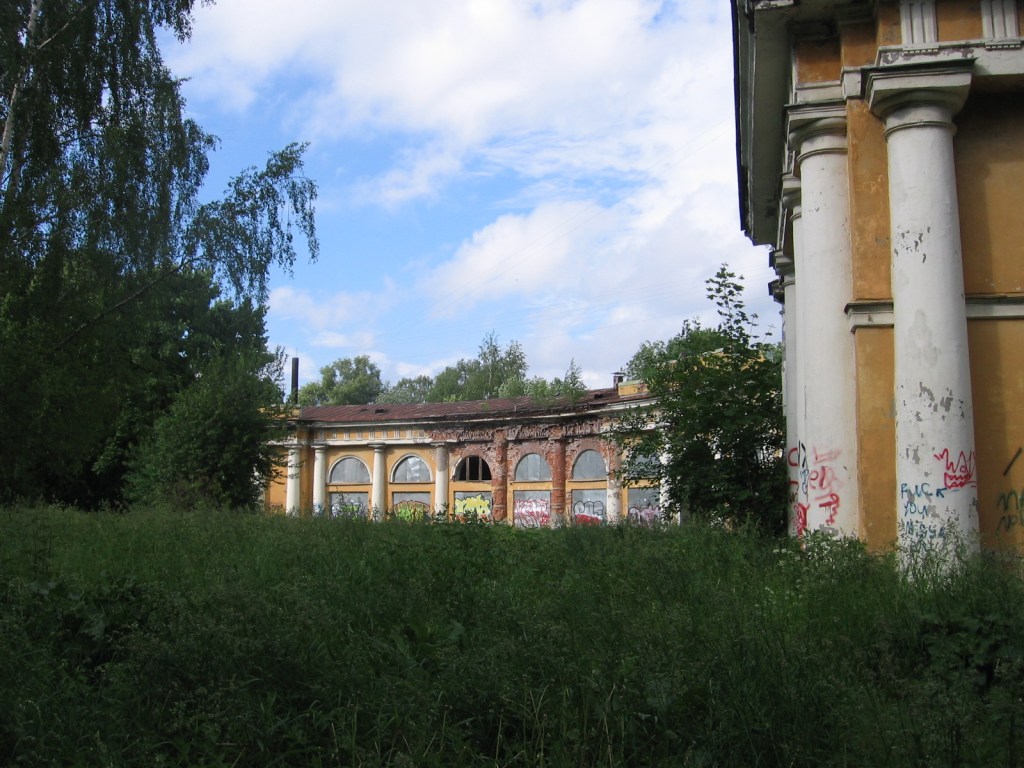
Film Photo Shoots at Rastvoritel (“Solution”)!

You can book a photo shoot in our pre-revolutionary retro-vintage interiors. You can see sample photos in this post.

– We love simple, semi-amateur, raw photos, although we always take our work professionally, of course.

– Our photos capture the natural essence of the moment and look fundamentally simple yet truly authentic.

– We shoot on film and enjoy experimenting. But we can also do more organized shoots.

– Our shoot will turn out great no matter what. Of course, we can’t always predict a perfect result, but that’s the essence of art.

We shoot with Zenit 11, Zenit S, Olympus, and Premier cameras.

🚩To discuss details and book a shoot, message us directly at @rastvoritel__

Rastvoritel Underground Art Gallery

📷 photos by @lena_eterna and @majestic_primitive_art

#saintpetersburg
#photography
#film
#35mm
#photoshoot

Source: Rastvoritel (Instagram), 7 September 2026. Translated by the Russian Reader


KYIV, Ukraine – It’s the last evening of my vacation.

I’m sitting in a taxi taking me to the Lviv railway station so I can return to Kyiv, and I can’t hold back my tears.

It’s not that I’m sad about returning to work and my normal routine. But when I get home, I know I won’t be able to sleep in my own bed. Once a cozy little nest, my own bed is now a place of constant fear, where even the deepest sleep comes at the risk of a ballistic missile or drone attack. I don’t trust monitoring channels anymore. I don’t trust anyone, except this primal fear that fills every cell of my body as soon as it starts getting dark.

And this fear is warranted. Russia has spent the whole summer launching large-scale ballistic missile attacks on Kyiv, taking advantage of Ukraine’s shortage of interceptors. They also used drones, including jet-powered Shaheds. Russia ramped up its missile production and also relies on North Korean missiles to intensify the attacks.

On top of that, Moscow seems to be adopting a new tactic, launching jet-powered drones throughout the whole day to paralyze the entire city. On August 27, there were 13 air raid alerts in Kyiv — a record-setting number of attacks lasting more than half a day. Since then, the attacks have been almost non-stop.

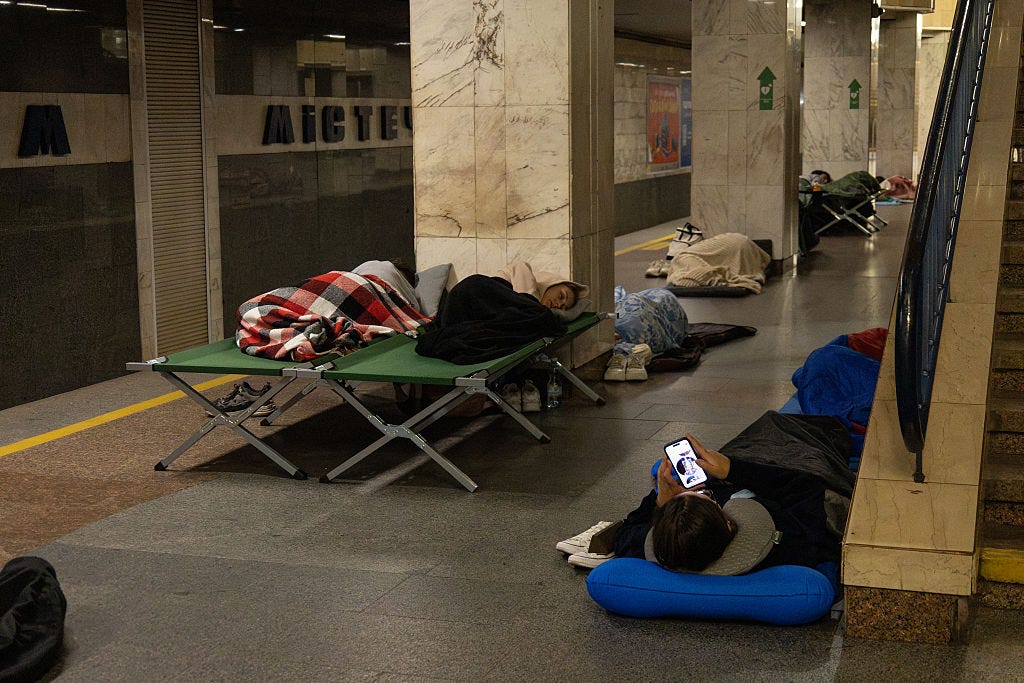
Basements and underground parking garages no longer feel safe enough. That’s why more and more Kyiv residents have started spending the night in the metro, often heading down there even before an air raid alert is issued.

A person checks a smartphone and others sleep as they take shelter overnight in a Kyiv metro station. Photo by Serhii Okunev/AFP via Getty Images and The Counteroffensive

Even when there’s no attack, people would rather spend a night in the metro than wake up suddenly to explosions in their own bed, unprotected.

Zoriana can’t sleep well anymore as the constant threat takes its toll

Night strikes started happening more and more in July.

I took the first few nights of ballistic attacks as something I simply had to accept. Last year, Russia had also stepped up its attacks on Kyiv during the summer, so I was mentally prepared for it.

But this time, they started using ballistic missiles more often.

I told myself that they would run out soon, since ballistic missiles are very expensive, while flinching at every new explosion in my bathroom.

But it only got worse.

Notifications about air raid alerts have become useless, as they only give two minutes before the first explosions, which can mean an endless night of hundreds of those two-minute windows and lots of panicked running.

So I couldn’t sleep well anymore.

My psychologist suggested breathing exercises and a ritual to help me calm down. But when I tried that, all I could hear was how hard my heart was beating.

That’s how my bed turned into a place of tormented waiting. Waiting for loud explosions and … my own death.

So I started going to the metro, regardless of whether there are air raid alerts or not.

Mariana wasn’t afraid of air raid alerts until this summer

I used to be pretty calm about air raid alerts. I went to the basement only a few times at the beginning of the war, when every alert was new and seemed scary and dangerous. But luckily, my hometown of Vinnytsia didn’t get attacked much. So I stopped going to the shelter and just continued on with my life, despite sometimes hearing the sounds of faraway explosions.

When I moved to Kyiv in 2023, I was a bit more cautious.

At night, the corridor became my sleeping spot during attacks. And although the explosions became more frequent, I still didn’t care enough to disrupt my sleep and go somewhere safer to hide.

But constantly seeing news of residential buildings completely ruined after massive attacks on Kyiv made me feel like the corridor was not enough. So in June, I started going to the shelter.

Zoriana wonders why she pays rent when she sleeps in the metro every night

People can go into the metro and stay overnight even without an air raid alert. Of course, you can wait and go once the alert starts, but I definitely can’t make it there in two minutes — the approximate time of a ballistic missile’s approach.

That’s why, at 10 p.m. every day, I have to decide whether or not to spend the night in the metro.

Without an attack warning, there aren’t that many people in the metro — typically around 30. I have already started to recognize a few familiar faces, and every evening we exchange a tired smile. But when there’s word of a massive attack coming, there’s not even enough room to drop a pin.

I have a separate warm tracksuit that I sleep in at the metro, my own folding bed, a comfortable pillow and a blanket. I always bring a thermos of tea, too.

But the constant thoughts never go away: maybe it will be quiet and I can stay home; maybe it won’t, and then it will be sheer terror.

Mariana sleeps better on hard school chairs than in a cozy bed at home

When I go home by metro at night, I see some people preparing to sleep there. They set up an improvised camp using mats, pillows and blankets. But even the metro can’t guarantee us complete safety.

At the end of July, the vestibule of the Lukianivska metro station, which I always use when commuting to my university, was damaged. At the time, people were sheltering there from the attack.

Since the closest metro station is 15 minutes from where I live, I go to the basement of a nearby school. I always bring a bottle of water and a sleeping bag with a pillow — they help me feel a little bit more comfortable while lying on hard school chairs.

I constantly check the Telegram channels that monitor incoming attacks, while other people in the basement whisper among themselves or snore. I hear the explosions outside, but it seems like the missiles can’t reach me in the shelter.

Eventually exhaustion gets the better of me and I fall into a restless sleep until I hear the all-clear signal. But I don’t leave the shelter right away. The thought of having to come back again because of another attack makes me stay until 4 a.m., the time when I for some reason feel that the threat is over.

With drones being launched constantly now, there’s no period of time that is truly safe. A new alert can come at any time, day or night. And when that happens, I’m too exhausted to care. I stay in my corridor and listen to the explosions, just hoping that I’ll be lucky and not get hit.

I’m consumed by only anxiety and exhaustion now, and whichever feeling is more intense at any given time is what dictates how I respond.

Zoriana fears this living nightmare made her a bad person

For the past two months, I haven’t been able to rest at all. There are no weekends or weekdays anymore, only day and night. Days filled with anxiety about my life. Nights full of fear and uncertainty.

And, strangely, I felt the worst when there was no attack. Exhausted, I walked home from the metro at 6 a.m. after taking shelter there overnight. That was when I caught myself thinking that I was sorry there had been no attack. I had wasted my night, and they hadn’t even bombed us. A second later, I burst into tears over that intrusive thought. How could I be disappointed that there was no attack? Am I really such a horrible person?

That was when I realized how much this is destroying me, dissolving everything joyful and bright that I had spent years filling my soul with.

It has been two weeks since my vacation ended, and I have slept alone in my apartment only twice.

I am still in Kyiv, trying to keep living my life. For how long? We’ll see.

And even as I write this right now, I’m packing my things for another night in the metro.

Source: Zoriana Semenovych and Mariana Stadnyk, “Why pay rent just to sleep in the metro,” The Counteroffensive with Tim Mak, 10 September 2026. As a paying subscriber to this Substack-based journal, I’m happy to share it with my own readers occasionally. ||||| TRR

The Georgy Pirogov Case and Russia’s High Treason Epidemic

Georgy Pirogov. Photo: FSB Public Relations Centre/TASS/ZUMA Press/Scanpix/LETA via Novaya Gazeta Europe

Two years ago, Georgy Pirogov, a Russian man who had moved abroad after the full-scale invasion of Ukraine, disappeared in Uzbekistan. He later resurfaced in a Moscow pre-trial detention centre. In July 2026, he was convicted of treason, and last week, the Federal Security Service (FSB) announced that the verdict had entered into force. The agency accused Pirogov of spying for Polish military intelligence and providing financial support to Ukraine’s military. According to the human rights group Department One, Pirogov says he was injected with an unknown substance before his removal from Uzbekistan. Novaya Gazeta Europe examines what we know about the case.

In early July, the Moscow City Court sentenced Georgy Pirogov to 23 years in prison followed by two more years of movement restrictions and a fine of 800,000 rubles (€8,100). Pirogov had left Russia via the United Arab Emirates after the full-scale invasion of Ukraine and settled in Georgia, where he worked as an industrial climber before travelling to Uzbekistan for work. His relatives lost contact with him on 6 July 2024, and his abandoned car was later found in the Uzbek city of Nukus. Just two days later, on 8 July 2024, a Moscow district court sent him to pre-trial detention.

According to an FSB press release, Pirogov “independently established contact” in April 2022 with a representative of Polish military intelligence and was tasked with gathering classified information about advanced weapons systems used by Russian forces against Ukraine. Russian investigators allege he obtained data on missile systems, as well as personal details of individuals with access to state secrets, through defence industry contacts. Prosecutors also claim he transferred cryptocurrency to fund Ukraine’s military, purchased military equipment, and arranged its delivery from Poland to Ukraine.

Information about Pirogov’s life is hard to come by. Two videos of him are publicly available: one from 2024, filmed in Uzbekistan, in which he describes the harsh conditions of his work, and another, undated, that shows him after his arrest ”confirming” to FSB interrogators that he had gathered information.

Novaya Gazeta Europe reviewed the social media profiles of several of Pirogov’s relatives and found no political posts, aside from a petition his sister shared five years ago on Change.org concerning a small-scale land dispute near Moscow. Records from Georgia’s National Statistics Office indicate that, until 2024, a man named Georgy Pirogov served as director and co-owner of the Namaste Hostel in Tbilisi. The hostel’s Facebook and Instagram pages feature photos and videos of a man closely resembling the Pirogov convicted in Moscow, and the accounts stopped updating around the time of his disappearance, though the hostel itself continues to operate. Its representatives did not respond to a request for comment.

Novaya Gazeta Europe found three documents connected to Pirogov’s case in a public legal database: two attempts by his lawyer to appeal his pre-trial detention order before the Moscow City Court, and a separate appeal against the seizure of his property. None of the motions succeeded.

Court documents show that Pirogov has elderly parents, holds a university degree, is unmarried, and had no prior criminal record. His lawyer said that Pirogov had “actively assisted in uncovering and investigating the crime” and had confessed, and that, contrary to the prosecution’s portrayal of him as a Polish spy stealing data for Ukraine’s armed forces, “no socially dangerous consequences” had resulted from his actions.

“The entire case behind the accusation [that he was working for Polish intelligence] was built on an FSB sting operation. Agents posed as one of his acquaintances and communicated with Pirogov under that person’s identity; the authorities later classified those exchanges as treason,” Yevgeny Smirnov, a lawyer with Department One, told Novaya Gazeta Europe. He said it remains unknown to what extent the FSB coordinated Pirogov’s abduction in Uzbekistan with the country’s own security services.

“They took him the simplest way possible — FSB officers flew in, detained him, injected him with some substance, and brought him to Moscow,” Smirnov said, adding that this account came from Pirogov himself, who gave it to explain how he ended up back in Russia after his arrest. The account raises questions: the substance would presumably have been meant to make Pirogov compliant with his abductors’ instructions, yet he would also have needed to appear sufficiently lucid to avoid arousing the suspicion of Uzbek border guards as he boarded the plane.

Smirnov noted that the charge brought against Pirogov has become commonplace in Russia. “[Charges of] treason in the form of espionage are extremely widespread right now — photographing military sites, sending data about military personnel, these things are now classified as treason,” he said.

Source: Alexander Leonidovich, “Drugged and disappeared,” Novaya Gazeta Europe, 18 August 2026


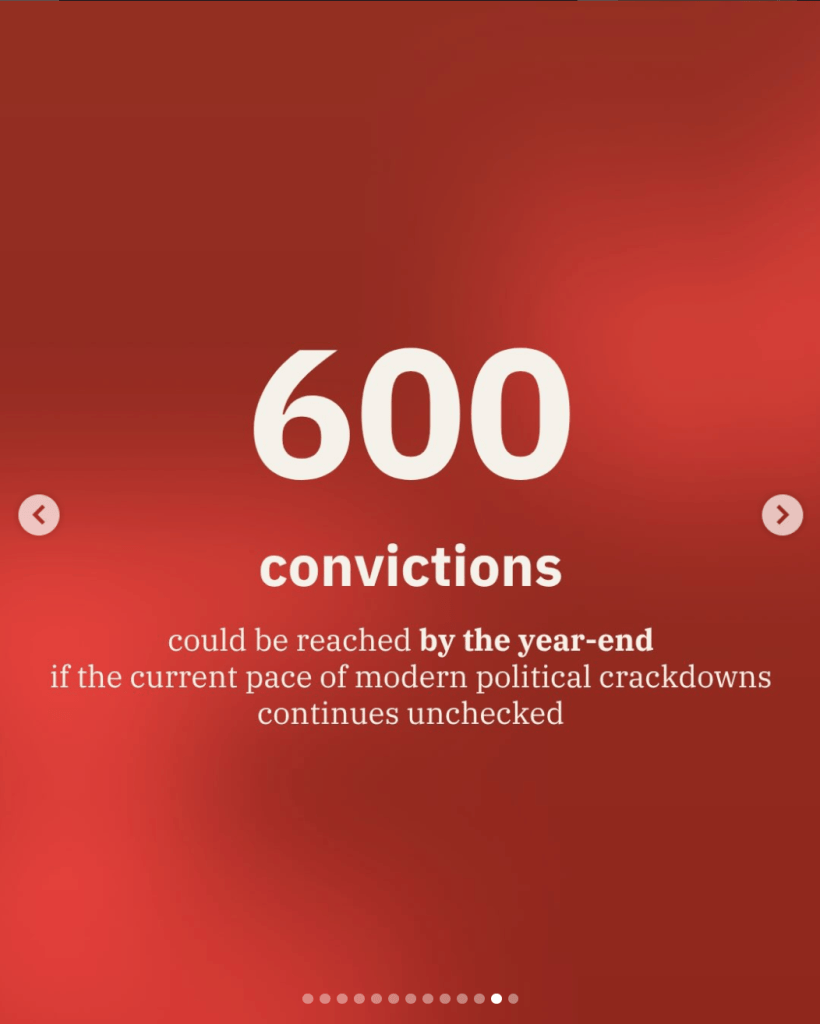
The legal framework inside Russia has undergone a fundamental shift since the expansion of wartime legislation.

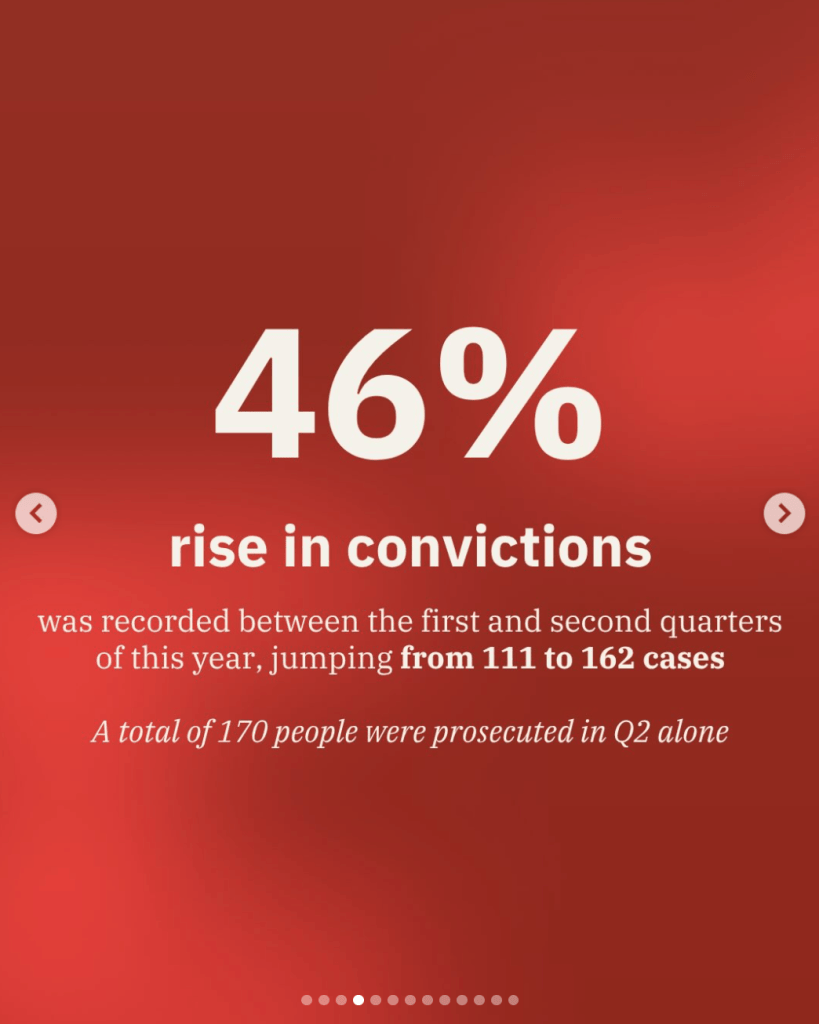
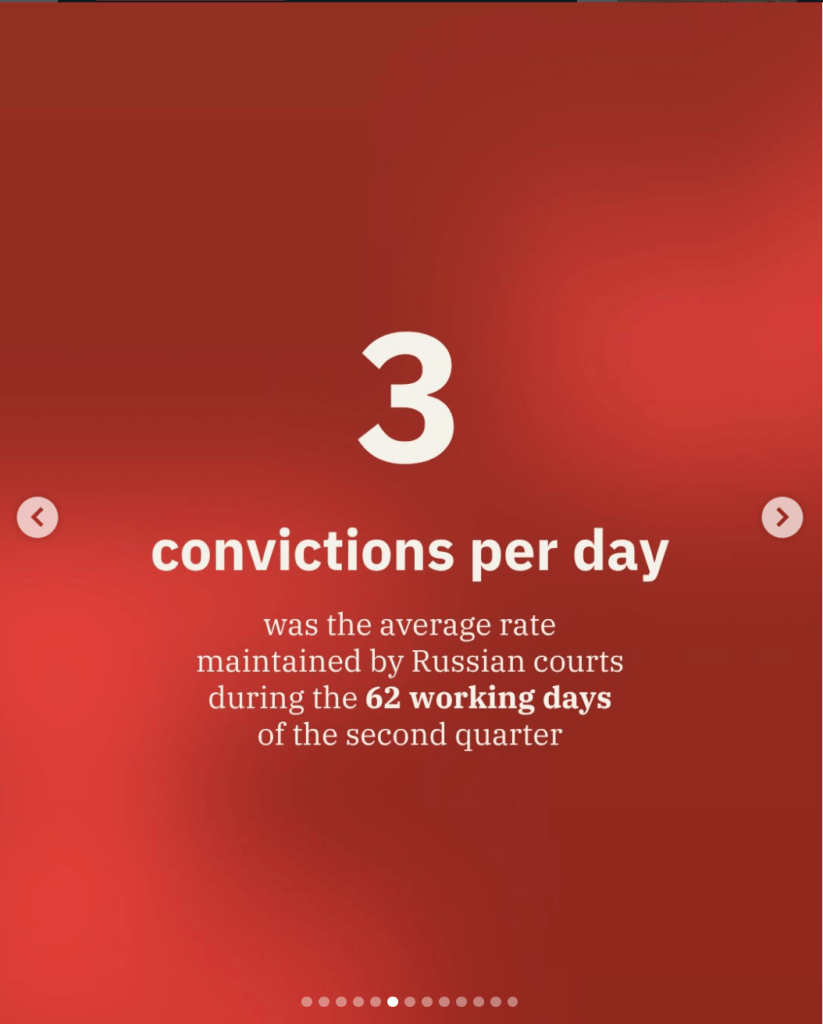
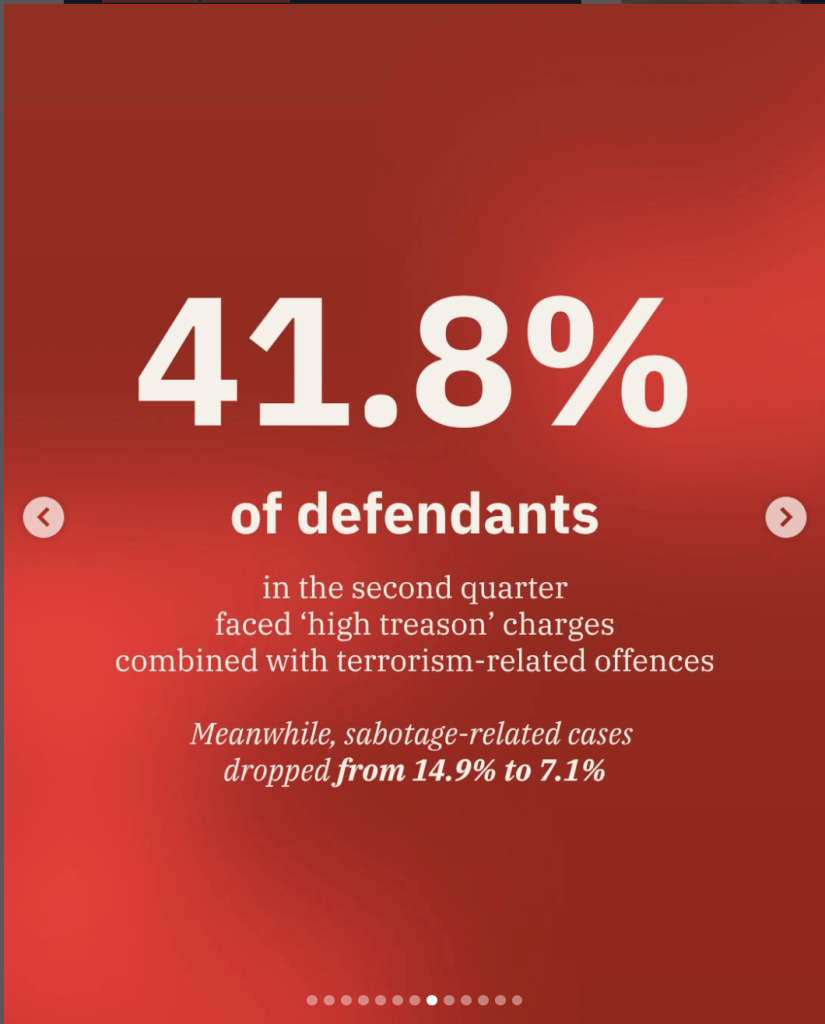
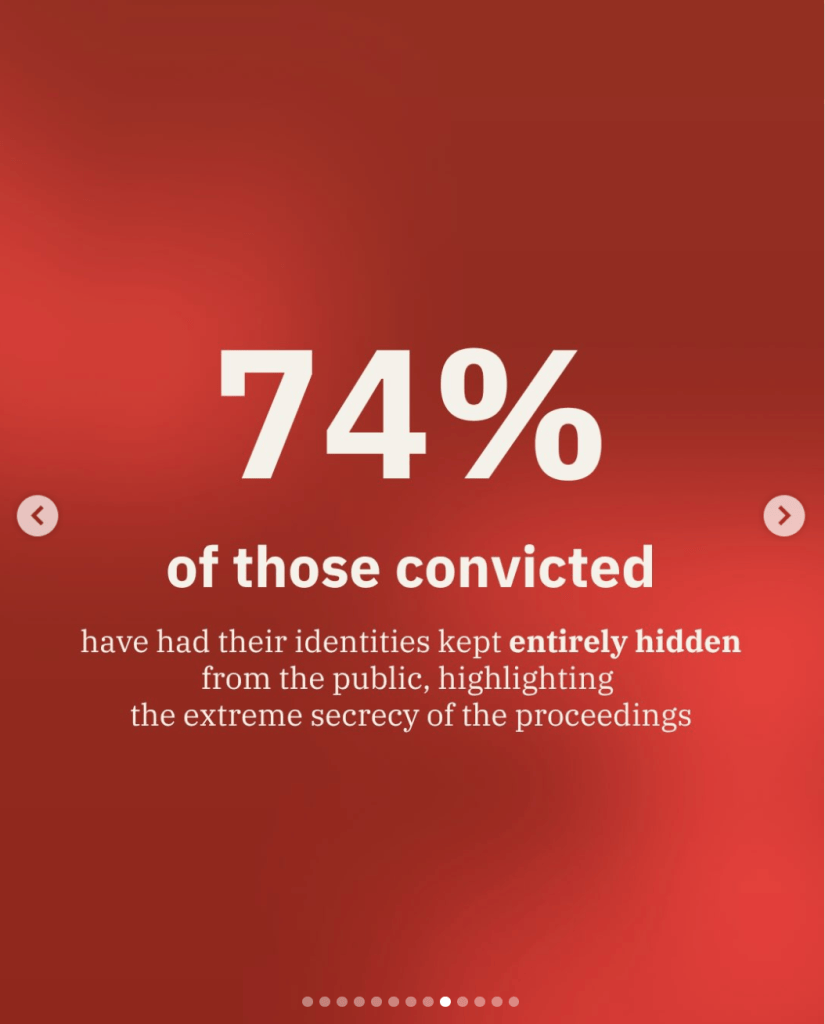
Charges of high treason and espionage, once rare, are now systematically deployed as standard instruments of domestic policy. The handling of these cases by the Russian judiciary is characterised by near-total secrecy, with the vast majority of trials held behind closed doors and resulting in lengthy penal colony sentences.

This data compiled by @one_dept documents the accelerating rate of these convictions. While the individual metrics are detailed in the slides, the broader picture reflects a judicial system restructured to neutralise dissent.

Swipe through for the key data points.

Source: Memorial.Prisoners (Instagram), 2 September 2026

Lida Moniava: A Heroine of Our Time

Lida Moniava (Facebook via Moscow Times)

Lida Moniava, a prominent advocate for critically ill children’s care, has been charged with spreading false information about the military, her attorney told Russian media on Wednesday.

Moniava was arrested following a police search of her home in Moscow earlier in the day and questioned by officials from the Investigative Committee, Russia’s top investigative body.

Moscow’s Simonovsky District Court is expected to rule on pre-trial detention measures, her attorney told the news outlet RBC.

The charge of spreading false information about the military carries a maximum sentence of 10 years in prison.

Moniava is the founder of the Moscow-based charity Lighthouse, which operates hospices for seriously ill children and young adults in the Russian capital and surrounding region.

After Russia’s full-scale invasion of Ukraine in 2022, Moniava created a foundation that provided shelter, medical supplies and food to people fleeing from the war. The organization also later helped Armenians fleeing from conflict in Nagorno-Karabakh, as well as Russians displaced from the Kursk and Belgorod regions.

That foundation suspended operations last September due to the dwindling number of refugees arriving in Moscow and the Moscow region.

Moniava was previously detained in January and in February. She was fined 45,000 rubles ($520) after being found guilty of “discrediting” the Russian military in posts on Telegram.

Despite facing pressure from the authorities, Moniava has refused to leave Russia.

“If I leave, critically ill children will end up in nursing homes and intensive care units for longer periods. Knowing that, I doubt I could live happily in some other country,” she wrote earlier this year.

Source: “Children’s Hospice Founder Arrested and Charged Over ‘War Fakes,'” Moscow Times, 2 September 2026


Lidia Moniava is being forced out of Russia. First, her hospice was slapped with an administrative fine. Then she was threatened with criminal prosecution. Next, a criminal case was launched against her, her home was searched, and she was interrogated. Now, the court has sentenced her to non-custodial remand. It’s the standard playbook: we’re about to lock you up, so hurry and leave; take advantage of this last chance. In unison with the punitive organs, the lucky political émigrés are chiming in, “Run, Lida, run!” Escape is the very essence of their political activism. Fleeing is their means of survival.

Forcing an undesirable person to leave is the best option for the authorities. That much is obvious. But it is also obvious that this “undesirable person” has a different set of values, different views on life and on her place in it. She cannot abandon a cause she considers important; she cannot betray the people who have placed their trust in her, the people she cares for. Personal responsibility is what Russian society so desperately lacks today.

She won’t have an easy time of it. It’s hard for a free person to live in an unfree country. But it’s a noble choice, one that only people who are free on the inside can understand.

Source: Alexander Podrabinek (Facebook), 3 September 2026. Translated by the Russian Reader


I always thought she was exactly what a Christian should be like.

Lida Moniava, the director of Lighthouse children’s hospice, has been accused of circulating “fake news” about the army. she has been detained and faces up to ten years in prison.

It is clear who is running a country where righteous people are behind bars.

Source: Natalia Vvedenskaya (Facebook), 3 September 2026. Translated by the Russian Reader


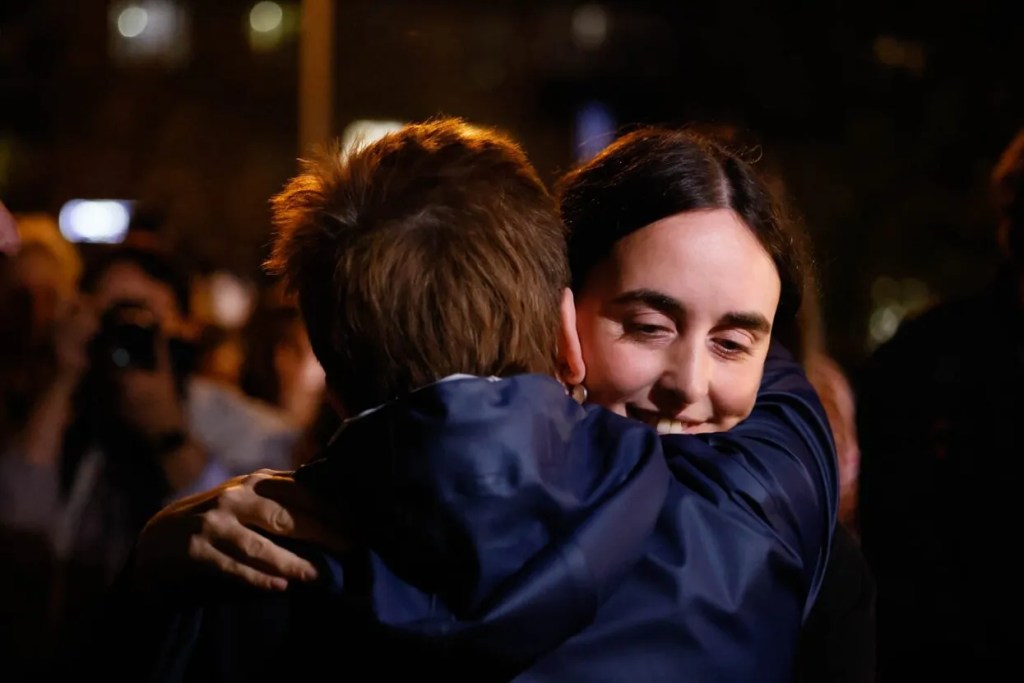
On the evening of September 3, Simonovsky Court placed Lida Moniava, founder of Dom s Mayakom (“Lighthouse Charity Foundation”), under a set of restrictions in a criminal case accusing her of spreading “fake” information about the Russian military. Moniava is one of the leading figures in contemporary Russian philanthropy: she founded the Dom s Mayakom charity and its hospices for children with severe and incurable illnesses. Dozens of people came to Simonovsky Court in Moscow to support her. The news outlet Bereg recounts what happened — and shows how Moniava’s supporters celebrated her release. Meduza is translating the report in full.


A hearing on pretrial restrictions for Lida Moniava, founder of the Lighthouse Charity Foundation, is scheduled for 5 p.m. on September 3. A full hour before the hearing, Muscovites who have come to support Moniava are already gathering outside the Simonovsky Court building.

Police searched Moniava’s home early on the morning of August 2 as part of a criminal case over spreading “fake” information about the Russian military, then arrested her. The case stems from a post Moniava published on her Telegram channel to mark the first anniversary of Russia’s invasion of Ukraine. “For a year now, my country has been sending missiles, tanks, and soldiers into Ukraine. For a year now, innocent people have been dying because of it,” she wrote.

A short young woman named Nadezhda stands in the parking lot reserved for official vehicles directly in front of the courthouse. She is visibly nervous. She introduces herself as Moniava’s goddaughter.

“I’m waiting for justice. If someone like Lida is sent to prison, something truly terrible will happen to the world,” Nadezhda says.

A mixed crowd gradually gathers by the parking lot: young people who might be described as part of the alternative scene, middle-aged people, and elderly members of the support group. Some call themselves Moniava’s friends and acquaintances; others, like red-haired Makar, dressed all in black, learned about her from recent news coverage.

“When I read about Lida, I realized she’s just an incredibly good person — kind, with the noblest intentions,” Makar tells the independent Russian outlet Bereg. “Of course, it’s a real shame things turned out this way.”

Makar says he is trying not to get his hopes up that the charges against Moniava will be dropped or that she will be released from custody, “so I don’t end up disappointed.”

Mikhail, an acquaintance of Moniava’s, is also there to support her. He speaks about her much as dozens of others have in Facebook posts supporting her over the past day.

“I admire what she does, what she stands for, and the fact that she’s open about it. That’s genuinely brave,” Mikhail says. “You can do charity work and still be a conformist because you think charity makes up for everything. But Lida did good work without becoming a conformist just to keep doing it.”

When Russia launched its full-scale invasion of Ukraine, Moniava stayed in the country and continued helping children with incurable illnesses. She also set up a fund to help refugees from Ukraine and Nagorno-Karabakh, as well as residents of the Kursk region’s border areas affected by the Ukrainian military’s incursion in August 2024.

While helping people affected by Russia’s invasion of Ukraine, Moniava also wrote antiwar posts on Facebook. In February 2026, Russian authorities fined her 45,000 rubles for “discrediting” the Russian military over those posts. She wrote about children killed in a Russian missile strike on Kryvyi Rih and the deaths of the Martynenko family — a father, a mother, and their 11-year-old son — in a strike on Sumy.

After the February hearing at which a judge imposed the fine, Moniava thanked her followers for their support and said in a post that she had “received a lot of advice to leave Russia”:

When Center E is banging on your apartment door, it’s scary, of course. But look at this photo — Anya and I are having such a great time on our shift [at the hospice]. She’s a girl who spent 19 years behind the walls of a residential institution. If I leave, children in palliative care will spend more time in residential institutions and intensive care units. I doubt I could live happily in some other country knowing that. So emigration isn’t in the plans.

In the same post, Moniava added: “I also can’t stay silent as if there’s no war. Trying to live honestly comes first for me.”

Natalya, who came to Simonovsky Court, does not know Moniava personally but has long followed her work. “I’m just in shock over what’s happening,” she says. “It’s probably to be expected, but it’s still very hard for me to accept. I’m an outsider looking on, and I simply respect her work, so I came here to support her. Lida is a wonderful person who helps others live and survive. That’s very important in our world. In turbulent times, we need to support each other somehow and do something.”

Others who came to support the Dom s Mayakom founder included Nobel laureate Dmitry Muratov, former editor-in-chief of the independent Russian newspaper Novaya Gazeta; Nyuta Federmesser, founder of the Vera Fund, which helps people with incurable illnesses; actress Tatyana Drubich, co-chair of the same fund; and Daniil Maksimov, a Vera Fund employee and founder of an inclusive magazine about sex for people with disabilities.

Maksimov, a blogger, writes on social media about living with spinal muscular atrophy (SMA) and the problems wheelchair users face. Several people in motorized wheelchairs gathered outside Simonovsky Court on the day of Moniava’s hearing.

The Lighthouse Charity Foundation needs support. In recent days, it has lost many donations and some of its donors. You can donate from Russia in rubles on the foundation’s website.

Shortly before 5 p.m., a prison transport van parked outside the courthouse pulls away. By now, around 200 people have gathered. Someone in the crowd says, “This one’s probably leaving now, and the next one will have Lida in it.” When another prison van drives onto the court grounds soon afterward, people start chanting, “Lida! Lida!”

The van’s barred windows make it impossible to see who is inside. The van pulls into the garage.

People line up to enter the courthouse, and the line moves very slowly. One woman in a blue jacket stands out among the crowd, holding a copy of Viktor Vilisov’s book Nas Vsekh Toshnit (We’re All Sick to Our Stomachs) with a bright orange cover. Off to one side stands Yekaterina Duntsova, head of the Rassvet (“Dawn”) party; somewhere in the same crowd are Tatyana and Valery Yashin, the parents of convicted politician Ilya Yashin, who was sent to Germany in a prisoner exchange.

“So many people showed up. This is a really high-profile case,” someone in the crowd says.

“Yeah, this isn’t Remeslo.”

Forty minutes later, the line still has not cleared. Two young men carrying tripods come out of the courthouse toward the line. Someone in the crowd asks hopefully:

“So, any news?”

“No, nothing at all.”

It is a little after 5 p.m. when Nyuta Federmesser, who had entered the courthouse near the front of the line, comes back outside. “Lida hasn’t arrived yet,” she says. “We came down because it’s impossible to breathe in there. There’s no point in standing here anymore because they’ll start kicking everyone out soon. The court closes at 6 p.m.”

Some of those who came are in no hurry to leave, even though it is very stuffy inside. Dmitry Muratov takes a spot right by the courtroom entrance. One woman who came to support Moniava offers people postcards to write warm messages on, which will later be delivered to Moniava. A police officer comes upstairs and asks everyone to leave the building: the court has closed for the day.

Everyone heads down to the courtyard, which is packed with people. In the middle, a group shares a pie. Police soon drive everyone out of the courtyard as well, and the gates close. Now everyone waits for Moniava by the fence.

Traffic police officers watch the crowd from cars with their emergency lights on. One of them approaches the crowd. What he says is familiar from rallies and pickets:

“Citizens, do not obstruct the passage of other citizens!”

“We’ve heard that one before,” a woman over 60 says. “I’m so sick of you!”

Word eventually spreads that Moniava has been brought to the courthouse after all and that the hearing has begun. The press is not allowed to attend.

“I know Lida personally,” says Fatima, who came to Simonovsky Court to support her. “Lida is a wonderful person. She’s done a lot in our country to help children with severe and incurable illnesses, and she built a palliative care system. Of course, it’s pretty horrifying that she’s inside the Simonovsky Court building at all.”

Neither Fatima nor Mikhail, who respects Moniava for refusing to conform, expects “anything good” to come of the judge’s decision.

Half an hour later, the crowd starts to stir. The courthouse doors open, and two security officers appear in the doorway. Several people start chanting “Lida!” but she is nowhere in sight. A few men come out, followed by a woman. “The workday is over,” someone in the crowd says.

As they wait, someone starts singing, but the words are impossible to make out.

Finally, Moniava’s defense attorney, Mikhail Biryukov, says from inside the courtroom that the court is releasing Moniava from custody and placing her under a “ban on certain activities.” While the investigation continues, she is barred from going outside between 8 p.m. and 8 a.m., communicating with witnesses, or using the internet.

Sometime between 8 and 9 p.m., Moniava and Biryukov emerge from the courthouse. The people waiting behind the fence chant Moniava’s name and applaud. Once outside the gates, she tells the crowd: “I thought I was going to get 10 years in prison. Some kind of miracle.”

She says investigators spent “many hours” trying to persuade her to admit guilt: “For some reason, it’s very important that the defendant say they feel guilty. I don’t feel guilty. I want the war to end as soon as possible.”

“Is there anything you want to do right now?” journalists ask Moniava.

“See my friends,” she says with a smile.

Source: “Chants, applause, and hundreds of supporters: A report from the Moscow courthouse where children’s hospice founder Lida Moniava faced a charge of spreading ‘fakes’ about the Russian military,” Meduza, 4 September 2026

The Art of Translation

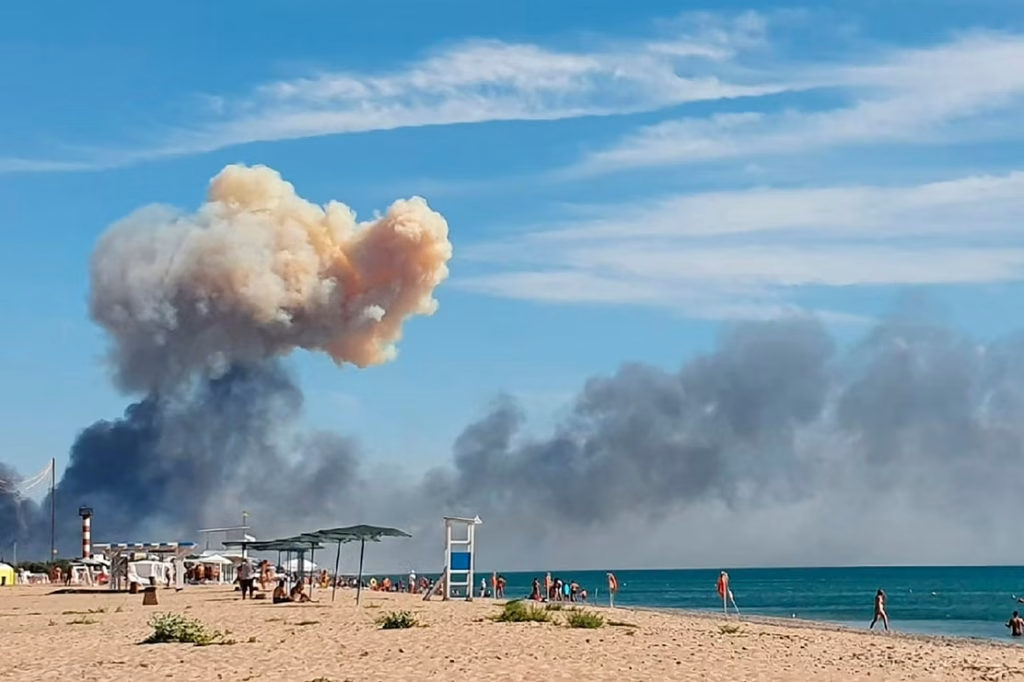
The first attack on the Saky military airfield, in the annexed Crimean peninsula, took place on August 9. Le Monde/AP

Lyudmyla Khersonska

When Crimea was still a place of light,

when gulls
were free
of orders,
when sandals
beat light
on the border
of water,
and gulls were the only patrols in the sky;
when women in bright dresses
walked barefoot or in cheap sandals,
in sandals, in sandals
instead of boots,
before missiles.
Before missiles,
I, too, loved it all.

Translated from the Russian by Ilya Kaminsky and Katie Farris


Когда-то во времена Крыма,

когда Крым еще не был горем,
когда Крым еще был морем,
и над морем летали чайки,
а в море резвились дельфины,
когда по берегу ходили в сандалиях,
а не в тяжелых берцах,
когда-то во времена солнца,
когда не было дыма снарядов,
когда в море не вбивали сваи
и не строили железную сушу,
тогда я все это любила.

Lyudmyla Khersonska is the author of About Today Is a Different War (Arrowsmith Press, 2023), and The Country Where Everyone’s Name Is Fear: Selected Poems (Lost Horse Press, 2022), coauthored with her husband, Boris Khersonsky, and translated by Ilya Kaminsky and Katie Farris.

About this Poem

“I [wrote] this poem after Russia annexed the Crimea. After this beautiful Ukrainian place [was] violently transformed into a Russian military base. I visited Crimea many times before the annexation. I loved its poetic tranquillity and inspiring landscapes. Now it is all gone. I might never be able to see it again. But I have it in my memory. I often think of my friends who used to live there before the annexation. They had to flee. Their house stays empty with the memory locked behind the door.”
—Lyudmyla Khersonska

“Katie Farris and I [collaborated] to translate this poem by Ludmyla Khersonsky [sic] who is a poet from Odesa, Ukraine, who is also a war refugee, currently living in Italy. Her writings have appeared widely in the U.S., including in The New Yorker and World Literature Today. She has written about war for many years and, to my mind, her writing stands in the tradition of other Eastern European poets, including Anna Swir, who write about crisis with hypnotic clarity and restraint.”
—Ilya Kaminsky

Source: Poets.org. In the original publication, the translators are credited right below the author’s name. Although this might have been an editorial decision, it does point to a sense of authorship on the part of the translators. I have tried to contest this claim by moving their names underneath their text, in keeping with convention, and by providing my own more literal translation of the poem, below. ||||| TRR


Back in the days of Crimea,

when Crimea was not yet sorrow,
when Crimea was still the sea,
and over the sea flew seagulls,
and dolphins frolicked in the sea,
when the shore was trod in sandals,
not heavy combat boots,
back in the days of sunshine
when there was no missile smoke,
no piles driven into the sea,
no building of an ironclad land,
in those days I loved all of it.

Translated, from the Russian, by the Russian Reader

Day of Knowledge

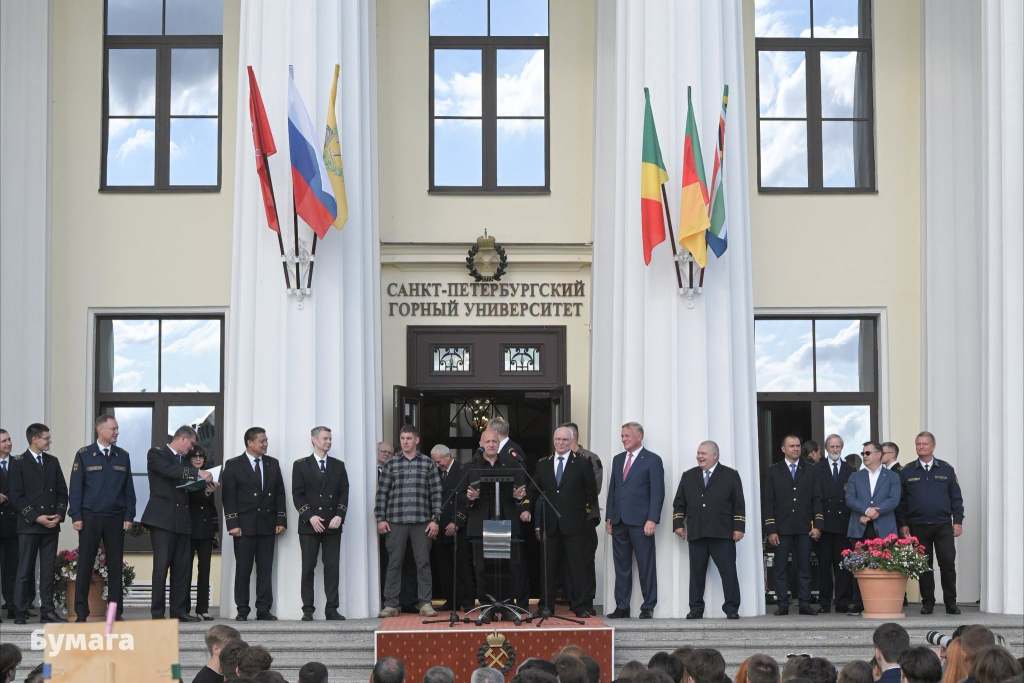
Zakhar Prilepin addressing an assembly at Petersburg’s Mining University. Photo: Bumaga

Zakhar Prilepin speaks at Mining University welcome assembly

Zakhar Prilepin was introduced as a “writer and participant in the Special Military Operation,” but was mistakenly referred to as “Prigozhin,” so he corrected the master of ceremonies, our correspondent reports.

Prilepin told the students that emigrating after receiving an education at the Mining University would be an act of treason.

“If you take your knowledge beyond the borders of this country, beyond the bounds of our national science, you will betray all those who stand beside you. I hope there is no one here like this, but some of you might secretly be thinking, ‘I was born so intelligent, I am so wonderful and gorgeous, and basically I’m entitled to everything, that I’ll just pack my bags and go off somewhere where they’ll pay me more for my brains.’ Please understand that this is a treachery against those people who have conquered and cultivated this vast expanse,” Prilepin declared.

Prilepin was the third to speak, after Rector Vladimir Litvinenko and one of his vice-rectors. On stage, the writer stood next to Litvinenko.

Source: Bumaga (Facebook), 1 September 2026. Translated by the Russian Reader


A wave of false bomb threats triggered mass evacuations at schools, kindergartens, hospitals and museums across at least nine Russian regions, local officials and media reported Tuesday.

In the Leningrad region, Governor Alexander Drozdenko said “a dozen” schools, kindergartens and hospitals responded to bomb scares. The hoaxes came amid Day of Knowledge celebrations that mark the start of the new school year every Sept. 1.

“We can’t ignore these threats, even though we understand the enemy’s goal to… ruin the holiday for children and adults,” Drozdenko wrote on Telegram, likely a reference to Ukraine.

St. Petersburg and Leningrad region police told the Fontanka.ru news outlet that “more than 100 institutions” received false threats.

In Moscow, at least four museums, including the Pushkin State Museum of Fine Arts, evacuated visitors or temporarily closed for what they called “technical reasons.”

A government building in the Far Eastern Zabaikalsky region and a number of hospitals in the central republic of Tatarstan were also reportedly evacuated.

Fake bomb threats were also reported across the Ural Mountains, the Yamal-Nenets autonomous district, the Orenburg region and the Krasnoyarsk region.

Mass bomb threats, which the Kremlin referred to as “telephone terrorism,” have periodically plagued Russian cities in the years before and since the full-scale invasion of Ukraine.

Source: “Bomb Threats Force Evacuations at Russian Schools,” Moscow Times, 1 September 2026


Prilepin greeted the 2014 ‘Russian Spring’ with delight as the realisation of long-held hopes for a resurgence of Russian power. He hailed the Crimean annexation as a vital turning point in Russia’s post-Soviet history, marking an end to the dominance of what he called the ‘hysterical’ domestic media coverage of the Russian military campaigns in Chechnya and Georgia, and expressing the hope that ‘the Crimean story will give a kind of super-brutal revolutionary impulse inside the country, so that it undergoes a metamorphosis’. Prilepin has been actively involved in the Donbas conflict, initially as a war correspondent and as an activist organising charity rock concerts in aid of the pro-Russian side and delivering humanitarian supplies to the local population. From 2015 to mid-2018 Prilepin was employed as adviser tothe head of the self-proclaimed Donetsk People’s Republic (DNR), Aleksandr Zakharchenko; in a move that has prompted speculation and conspiracy theorising when, Prilepin, citing health problems, left Zakharchenko’s service a few weeks before the latter was assassinated in August 2018. Apparently on commission from Kremlin ‘grey cardinal’ Vladislav Surkov, Prilepin published a popular biography of Zakharchenko in 2016.

In early 2017 Prilepin’s involvement in the war moved to another level after he announced that he was forming his own battalion to fight in the Donbas for the DNR. This led to his being hailed in the newspaper Moskovskii komsomolets as not just both writer and soldier, but also ‘perhaps, a prophet’; the popular tabloid Komsomol’skaia pravda described him as a ‘hero of our time’ for the 2000s, and the‘Byron of Donetsk’. Other commentators predicted that Prilepin would write ‘the first great novel’ about the war in the Donbas, which ‘our children and grandchildren will use to study the history of the second decade of the 21st Century’. Prilepin followed up his announcement with an online videoclip in which he held up a peace sign and delivered a mock-serious speech about the writer’s duty to oppose war, before tearing up the peace sign and ordering his men to open fire on Ukrainian positions.

Source: Julie Fedor, “Spinning Russia’s 21st Century Wars: Zakhar Prilepin and His ‘Literary Spetsnaz.’” The RUSI Journal, vol. 163, no. 6 (December 2018): 20–21. https://doi.org/10.1080/03071847.2018.1562015.

Bashmakovo Bands Together to Battle Press Gangs

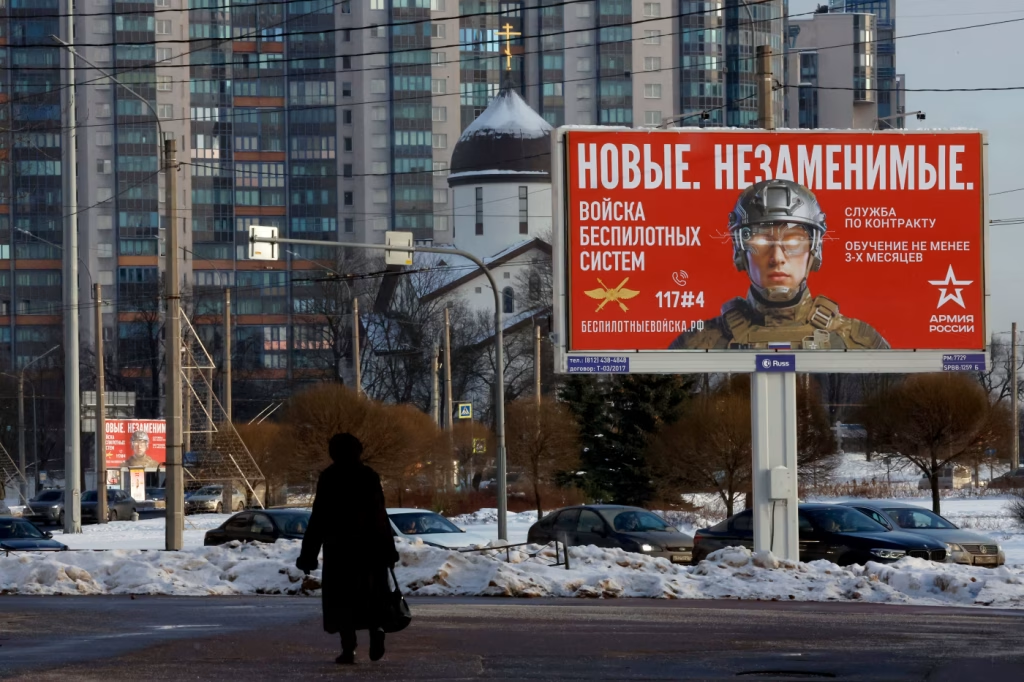
A billboard advertising voluntary (“contract”) military service in St. Petersburg, Russia. Source: Wall Street Journal

Raids aimed at forcing men to fight in the war against Ukraine have become widespread throughout Russia’s regions. In the Penza Region, where law enforcement, in concert with officials from military registration and enlistment offices, have been carrying out such raids in a particularly aggressive manner, local residents have banded together to “take back their men,” as they put it.

“They took him away, but we caught up with them halfway and got him back”

On 23 July, unknown men in plain clothes drove up to the home of Sergei Teplyakov, an employee of a local security firm in Bashmakovo, a district council town in the Penza Region with a population of around nine thousand).

“One of them introduced himself as the new neighborhood beat cop and demanded to see [Sergei’s] passport. Sergei then started phoning the real neighborhood beat cop. [The intruders] flew into a rage, grabbed him, and dragged him into their car. It was a straight-up abduction: no grounds for his arrest, no names, no paperwork whatsoever were provided,” says Oksana, a resident of the town. (We have changed the names of those whom we interviewed for their own safety.) “Sergei’s son, who had been telephoned by the neighbors, arrived, started filming it on his phone, and shouting at them. They let [Sergei] go. But the next day, [Alexei] Denisenko was caught in a raid.”

According to the locals, two unknown men grabbed Denisenko in a park where he was cutting grass to work off court-ordered community service hours for drunk driving.

“They threatened [Denisenko]. They said he would suffer the consequences if he didn’t go with them to the district council offices. A female council staffer was in the car with the ‘trappers,’ and so [Alexei] believed them. Plus, the license plates on the car were local, and it was a council vehicle,” says local resident Artyom. “He was told they were taking him to the council to ‘verify his details.’ But witnesses noticed they drove him off towards Penza and they called his family. His sister was able to chase them down halfway there, less than a hundred kilometers from Penza. She forced them to stop their car and she wrested Alexei from their clutches. These ‘recruiters’ are local officials working for the Defense Ministry by supplying them with unsuspecting folk. It’s utter lawlessness: these recruiters barge straight into people’s homes. If a man is walking down the street a bit tipsy, he’s definitely at risk. But basically, they’ll grab anyone.”

According to Mediazona, which has been compiling a name-by-name list of fallen Russian servicemen since 2022, more than two thousand residents of the Penza Region are known to have been killed in combat. The list of those killed from Bashmakovo includes twenty-five people.

Bashmakovo residents say that they had never met any of the “recruiters” before.

“We looked up the drivers of these vehicles—it turned out that one of them works as a bailiff!” says Artyom. “The plates of the second vehicle (O217XR) are registered to the Bashmakovo District Council. The families of Denisenko and Teplyakov reported the attempted abduction and coercion into signing military contracts to the police. Recently, two more men were also abducted. They managed to get a lawyer sent to them, but it wasn’t possible to get them out of the recruitment center on Skladskaya Street in Penza: they’d already been pressured into signing up there. According to the lawyer, one of them was threatened with ‘criminal charges’ over debts, even though the amount he owed didn’t warrant criminal prosecution. In other words, they were basically hoodwinked.”

Following these incidents, the locals decided to form a neighborhood watch group to defend the men.

“I joined the patrols almost straight away. It all happened spontaneously,” says Galina, a resident of Bashmakovo. “The guys set up [an online chat] group and started posting there about what was happening in the town and how they were rounding up the men. Gradually, people simply got together on VKontakte. That’s where we coordinate our efforts: we’ve split into shifts and we patrol the town around the clock. Around 250 people have joined the vigilante group. It’s much more effective to take back people on the spot, before they’re sent to the police station or the military recruitment office, because there’s simply no legal basis for detaining them.”

She says that almost everyone in the vigilante group has personal motives.

“There’s fear for our loved ones, of course. God forbid that my husband goes off to work and then disappears: you already know what might have happened to him. In June, they took my cousin away. He has two children. I recently found out that he had some sort of unpaid loan. I don’t know where he is now and what’s become of him.”

Galina says the members of the neighborhood watch patrol Bashmakovo every day and even at night: those who have cars drive around the town to check for suspicious vehicles or strangers. The volunteers chip in for petrol. They also use a community fund to cover unexpected expenses. Recently, during a patrol, there was a minor road accident in which two cars were damaged. They were repaired free of charge by acquaintances at a garage, and the only cost was for the spare parts.

Galina herself has been called out in response to a report of an attempted abduction.

“I was with my mom at the hospital when a message came through the group chat saying that two police officers were trying to force their way into Pavel Berdechenkov’s house. My mom and I drove over there, and the rest of the crew joined us. In the end, the police had nothing to say: they got into their car and drove off. There was another incident when we were patrolling a neighboring village and spotted a GAZelle van we didn’t recognize. All such reports go straight to our private group.”

She estimates that the vigilante group’s members have managed to prevent at least five or six people from being abducted in this way. But their methods doesn’t always work.

“Today we weren’t able to rescue a man because the alert came in too late. Within forty-five minutes, they’d already taken him far away. That’s why what matters most is that we’re notified straight away. Then we can get to the scene.”

A member of the volunteer group claims that at least two vehicles belonging to district authorities have been used in the raids. According to her, a Lada Granta, which residents have dubbed “401,” belongs to the Bashmakovo District education department, while a Lada Largus 217 belongs to the district council. Locals blame the council’s chair, Tamara Pavlutkina, for what is happening and feel that reporting incidents to the local police is pointless.

“There’s no point in complaining to the police. We believe the district council chair gives the orders and the rest just carry them out. She gets everything done by proxy,” says Galina.

Tamara Pavlutkina

As an example, she cites the story of fifty-eight-year-old Sergei Milkin from the village of Podgornoye, sixteen kilometers from Bashmakovo. According to her, the local beat cop, Sinyov, invited Milkin to the village council “for a chat,” after which he disappeared. Milkin, says Galina, had serious heart problems: he’d had a bypass operation. The day after his chat with the police officer, he rang his family from the Rostov recruitment center and told them he was being sent to the war. Ten days later, he died, basically on the front line.

“We wrote to every relevant authority: the military prosecutor’s office and Bastrykin at the Investigative Committee, and we appealed to the television. Our complaint was registered, and then there was silence.

Another member of the vigilante group, Alexei, joined it after his relative was nearly sent off to war.

“He was summoned by letter to the military registration and enlistment office to ‘verify his details.’ We happened to be visiting him at the time and witnessed the whole thing. The round-ups had begun in Penza by then, but not here yet. What’s more, he didn’t go alone but with a friend, so we felt a bit more reassured. He’d left his phone at home,” says Alexei. “Two hours went by, but he wasn’t back yet. Three hours passed, and still nothing. His friend returned alone and said, ‘Your relative’s gone to Penza for a medical board.’ We were in a panic. I rang the infamous Penza military registration and enlistment office at 19 Skladskaya Street. They replied, ‘We’ve got no one by that name here.’”

Alexei says that at that moment the village chair came to the house and asked for the missing man’s military service card.

“I started filming her straight away. ‘What grounds do you have for asking to see his papers?!’ I ask her. She replies, ‘The council sent me.’ I ask her to give me names and job titles, but she refuses. We take a taxi to Penza. At 19 Skladskaya Street, we race up and down all the floors. We come across a drunk man whom someone had brought in, while the bloke accompanying him boasts that he’s already brought in and ‘handed over’ two people that day. Then we meet a tearful mother: her son had been snatched straight from their home, and she’d rushed there hot on their heels. Her [other] two sons were already at [the front]. She said she won’t hand over the third one.”

Alexei spotted his relative right on the steps of the military registration and enlistment office.

“He had been brought there in a private car by an ‘acquaintance’ of the village council chair. When we shouted at this man, he claimed that he had nothing to do with it: he had just ‘kindly’ given [my relative] a lift to Penza. Then he scrammed. We immediately took our relative by the arms, but by that point he had already been ‘psyched out’: they’d explained to him that after the medical examination he would have to sign some papers, supposedly to verify his details. What sort of people are they? They’re a disgrace. They’re prepared to take people’s lives for these payments.”

Meanwhile, Oksana, who has also joined the group, told [Radio Svoboda] that the local authorities had begun putting pressure on them.

“The security forces have already threatened us. Do you know what they threatened to do us? To send us off to the war! What’s more, they’ve been openly persecuting those who have criticized the raids or written about them on social media. Police officers went straight to the home of Vera Makavtsova and, in front of her four children, threatened her with criminal charges. They are threatening to charge her under Article 319 (“insulting a public official”). All because, in a post of hers, she called the district council accomplices to the abductions, and its chair, Tamara Pavlutkina, a co-organizer of press-ganging people into combat.”

In an audio recording made during Makavtsova’s arrest, police officers can be heard bursting into the house and demanding that the woman “come with them.” This is because she allegedly “poses a threat to Russia’s national security,” posts all manner of “extremist” content on social media, and takes part in meetups of residents.

“You don’t have a warrant,” Makavtsova says.

“Do you have a fucking warrant to gather in the city center on Saturdays?!” the police officer replies.

“In the end, they busted down the door and detained her. Of course, it’s not domestic violence, her husband beating her [that brought the police to Makavtsova’s home]. It was a post attacking an official and the Defense Ministry. That was grounds for the police to ‘intervene.’ They never responded to the complaints from Denisenko and the Teplyakovs. I’m sure Pavlutkina herself filed the complaint [against them],” Oksana says indignantly.

“The chair of the council has two sons,” adds Galina. ‘When I asked her why she wasn’t sending her own sons [to the front], she said, ‘I didn’t give birth to them for that.'”

Meanwhile, on 25 June, a ceremony was held at the Bashmakovo District Council to present state awards to the local families of men killed during the invasion of Ukraine. Relatives and loved ones of the soldiers, who had returned home as “Cargo 200,” received honors and medals. The ceremony was attended by the local military enlistment officer, Alexei Valygin, and Pavlutkina, a member of the ruling United Russia party, who assured those present that “should any questions arise, citizens can always contact the district council.”

[Radio Svoboda] reached out to Pavlutkina, asking her to comment on reports that the district council had been involved in detaining residents and forcing them to volunteer for the army. As this article went to press, she had not responded.

In early August, Penza-based blogger Stanislav Morozov set up a support chat group for men who have been detained and pressured into enlisting in the army. He called on residents to unite to resist such detentions.

“We are doing this out of desperation, because we simply have no other choice. We are people who are standing up for our fundamental rights and freedoms—the right not to be treated as a commodity and not to have our free will taken away under the threat of a truncheon. When lawful means of self-defense cease to work, the only shield left is a neighbor’s shoulder. Our strength now lies in this compulsory yet consciously chosen consolidation,” Morozov explained in the chat’s overview.

Within the first twenty-four hours, 300 people had joined the chat, and within a week the number of participants had exceeded 1,200. Morozov calls on eyewitnesses to report arrests promptly and promises to help find lawyers for those detained. He warns that security forces and provocateurs may have joined the chat and asks everyone to be careful with what they say.

Amid the raids, other ways of warning people about them have emerged. In early August, an online service launched featuring a map on which users could mark the locations of arrests. A few days later, its developers reported that the service and its associated Telegram channel had been hacked, and the website had started redirecting users to a porn site, according to the Telegram channel Mobilization. The project’s creators speculated that the law enforcement agencies might have taken an interest in them, but it is not yet possible to independently ascertain who was behind the hack.

“They’ve taken a blind man away!

All across Russia, men are being deceitfully lured into the war against Ukraine.

On 8 August, an incident involving abduction and the forced signing of a military service contract took place in Omsk.

According to Valentina, on Saturday morning three unknown men grabbed her 31-year-old brother, Danil, straight from the courtyard of their home in Omsk’s Kirovsk District.

“He has a wife and children. This morning, he took a can of beer and went to sit on a bench by the entrance to his block. That’s where they picked him up. It was a private vehicle, but luckily, the neighbors managed to write down the license plate number. While we were looking for him, he came back on his own. He told us they’d taken him to a ‘volunteer’ recruitment center at 8 Maryanovskaya Street. He had barely managed to break free and escape, and he hadn’t signed anything. Well, we calmed down a bit,” says Valentina.

But that same evening, she says, they came for him again.

“Danil was out in the courtyard with his wife and children. Some men arrived in a Niva [off-road vehicle]. They twisted his arms behind his back and took him away to parts unknown. The children were screaming, and his wife tried to fight them off, but to no avail. We were terrified: what should we do? We started dashing off statements to the military prosecutor’s office, the military Investigative Committee, and the police. We found out he was back on Maryanovskaya Street. We’re demanding his release, but they won’t even let us speak to him on the phone. It’s a proper kidnapping.”

Her brother was released after some time, but, according to Valentina, he had been beaten up beforehand and forced to sign a “voluntary” military enlistment contract.

“They’ve finally let him go, but they intimidated him so much and beat him up so badly, that he signed the contract. We’re in shock at the moment, trying to raise money for lawyers. What else can we do? He’s at home for now, but they’ve got that contract they forced him to sign. They could turn up and break down the door, after all. What’s going on is just horrific.”

In August in Russia’s Maritime Territory, according to Ivan, a former soldier, the military stopped his brother Mikhail, who has a category 1 visual impairment.

“On 3 August, Misha went to the shop. He was stopped by two soldiers who initially asked him to sign a contract with the Defense Ministry,” says Ivan. “My brother refused. He told them straight away that he was a person with a category 1 visual impairment. They kept pressuring him: ‘Then you’ll be building barracks in Sibirtsevo’ (a village in the Maritime Territory’s Chernigovsky District, where military unit 16871 is stationed). He explained to them at length that he could hardly see anything at all. He’d been making his way to the shop by memory and by touch, after all. Then they grabbed him and took him away by force.”

The following day, Ivan (who had himself been discharged due to an injury sustained in combat in Ukraine) brought all his brother’s medical records to the recruitment center in Ussuriysk.

“They were holding him at the recruitment center on Lermontov Street. I showed them his medical records and his Category 1 disability certificate. I was certain they’d sort it out and let him go. But early the next morning, Misha rang and said they were putting him on a bus to the airport,” says Ivan. “That was it! He was off to Ukraine to fight. How on earth will he manage there?! He can only cope here on his own because he knows the streets like the back of his hand. But over there, he won’t even be able to get around. What do they want with him?!”

Mikhail’s family filed a complaint with the military prosecutor’s office claiming that he had been coerced into signing a contract.

“They said they had thirty days to respond. But how can we wait when a blind man has been whisked off to a war zone? He’s in danger there every single minute!” exclaims Ivan indignantly.

Human rights defenders note that after someone signs a contract volunteering for the army, it is extremely difficult to get the agreement annulled, even if he alleges that he was coerced into signing it.

“Coercion is illegal in theory, but if the contract has already been signed, annulling it at one’s own request is nearly impossible. In this case, one also has to file a written request with the military commissar to withdraw from the contract,” says Yaroslav Mukhin (whose name has been changed for his own safety), a lawyer specializing in cases involving conscientious objectors. “But experience shows that even medical certifications of disability are no longer of any help. The case may well go to court, but by the time the proceedings are over, a conscript in such poor health will already have been killed [in combat].”

Raids on men in Russia have been taking place amid growing challenges with recruiting volunteers. The Financial Times reports that the Kremlin and the Defense Ministry tasked the regions with recruiting 409,000 men in 2026, and it is up to local officials to fulfill the recruitment quotas. Meanwhile, the costs of recruiting itself have increased. Important Stories calculated that in the first quarter of 2026 alone the regions paid recruiters 3.2 billion rubles [approx. 33 million euros], which is more than twice the monthly average a year earlier.

In early August, the Wall Street Journal reported on complaints of men being detained and forced to volunteer for the army in Penza, Ulyanovsk, Rostov, Amur, and Yaroslavl regions, as well as Udmurtia, Tatarstan, Voronezh, and Arkhangelsk. According to the newspaper, American officials believe that the Kremlin is considering a larger-scale option: a new round of mobilizations. If such a decision is made, the newspaper’s sources expect it to be implemented after national parliamentary elections on 18–20 September. Russian authorities deny plans for another mobilization.

Source: “‘People have put together a militia’: How Russians are fighting back against recruiters to protect their men,” Radio Svoboda, 14 August 2026. Translated by the Russian Reader. Thanks to Comrade Koganzon for the heads-up.

Where Apocalypse Is Now

Utkina Dacha, St. Petersburg, 17 June 2012. Photos by the Russian Reader


Last week on a bus to Leningrad, as a bottle was passed around, I got angry for Finland. The Finns aboard found this very funny. For three hours we jolted on atrocious roads through [the] Karelia[n Isthmus], former Finnish heartland gobbled by Stalin in the Winter War of 1939, then regained and lost again during the Second World War. Amid forests of birch and pine, I glimpsed a long disaster. This was my first time in the USSR (my fourth in Finland). I was unprepared for the brokenness of every human thing, the old Finnish farmhouses and lakeside villas collapsing or collapsed, the travesties of farming apart from neat kitchen gardens. The once famously cosmopolitan Baltic port of Vyborg (Viipuri in Finnish), which could be the prettiest small city in the world, felt post-nuclear, its citizens (non-Finns, with whose forebears Stalin replaced the native population) listlessly wandering. Some gaped as our fancy tour bus wallowed by. The single purposeful activity I saw in [the] Karelia[n Isthmus] was that of a man painting an ornamental fence around a roadside ammunition bunker. The contrast to Finland’s grace and bustle was unbearable.

“Vyborg,” I said to the Helsinki art critic Markku Valkonen, who has Karelian roots. “You want it back.”

“Sure, I would like it back,” he said softly, “but I do not want to spoil my life with bitterness.”

[…]

I thought of it again in Leningrad, where apocalypse is now. The city is huge and grand beyond anything I expected. Its nineteenth-century buildings by C. L. Engel, who also worked in Finland, gave me a first impression of an imperial Helsinki, with aspects of Paris and Amsterdam thrown in. But the beauty is a patch that unravels within a block of the Winter Palace, exposing uniform squalor. The tour went to the Hermitage. There I was overwhelmed by the Rembrandts and by a room of Matisses that nearly forced me to my knees. Like other lovely things in Leningrad, the staggering holdings end abruptly in 1914. Meanwhile, in a separate building of the Hermitage, there was a show of—get ready—Peter Max. I wish I could find that amusing. But the evidence of near-term Soviet vulnerability to Western hustlers is too awful. With its stupid Revolution finished, the USSR may be in for a flood of imported stupidities.

Source: Peter Schjeldahl, “Baltic Views” (Village Voice, 11 June 1991), in Hot, Cold, Heavy, Light: 100 Art Writings, 1988–2018 (Abrams Press, 2019)

Space Can’t Kill Puppets

Still from Strange New Worlds, Season 4 Episode 5: “Level-Five Transporter Accident”

Ukraine has been carrying out intensive attacks on Russia’s export infrastructure along the Black Sea coast and on oil refineries across the country. Optimistic observers predict significant challenges for the Russian economy and, as a result, a depletion of the resources it needs to wage war. In light of this, common sense dictates that responsible politicians should return to the negotiating table.

The outlook is bleak because the Russian regime is devoid of responsible politicians who would be swayed by common sense. The political elite inhabit another reality—a reality in which they are doing a crackerjack job with the economy, inflation remains at tolerable levels, there are no hiccoughs with petrol (the Kremlin’s limousines don’t fill up at ordinary petrol stations plagued by kilometers-long queues, after all), the populace unanimously supports the war, and the deaths of hundreds of thousands of men at the front are mere collateral damage, not a serious demographic blow to the country. The regime are doing a great job with everything, and there is nothing to worry about. And the regime has the police, the FSB, the Investigative Committee, the prosecutor’s office, the Russian National Guard, obedient judges, and the penitentiary system to deal with the malcontents.

That is why the political crackdown will ratchet up in synch with the worsening of the military or economic situation and the rise of popular discontent. Russian history is chockablock with examples of when growing discontent, fueled by grassroots hardships, was nipped in the bud by the most brutal terror. Examples include the Russian Civil War and the Holodomor. The Russian authorities have never spared their fellow citizens, whether to further the war effort or to protect their own privilege.

Certain dreamers among the opposition bank all their hopes on a Ukrainian victory: in their reckoning, it would open a window of possibility to rebuilding politics in Russia. This is actually possible: it has happened in Russian history that military defeats have kickstarted democratic reforms. But it happened under weak regimes, despotic regimes which were frittering away their potential. Does anyone imagine that the current dictatorship is on its last legs and willing to make concessions to society?

Pinning hopes on the force of Ukrainian arms is not only naive but also dubious morally speaking. It is naive because by and large Ukraine could not care less about Russian domestic politics. No one will roar into Moscow on Abrams tanks and bestow either liberty or an occupation government on Russians. This is unrealistic, especially considering that Russia’s irresponsible politicians have their hands on nuclear weapons (a big thanks to Soviet physicists). Hypothetically, military defeat could embolden the society to protest, but in this case, as I noted earlier, the Kremlin has a wide range of tools for cracking down on dissent, and it has a wealth of experience in using them.

The hope that Ukraine will emerge victorious from the war is quite popular among Russian political exiles. This is partly because there is nothing else they can do to liberate Russia. Well, almost nothing. Donating to the Ukrainian Armed Forces is easy, and it washes away all their sins as exiles. It’s like going to church, lighting a candle, making a small offering, and assuming you’ve earned your place in heaven. As gestalt therapy it will do the trick, but it is quite dubious politically. It is disgraceful to reap the rewards of others’ hard work. Counting on a Ukrainian victory as a means of liberating Russia from dictatorship is not a particularly honorable strategy for the opposition. Victory must be forged with one’s own hands, not those of others.

In the last century, the White émigré National Alliance of Russian Solidarists (NTS) had a fine slogan: “No one will do Russia’s business for us.” Bitter experience gave birth to this slogan: the White movement’s betrayal by the Entente, the West’s economic aid in industrializing USSR, the surrender of anti-Stalinist military units at the end of the World War Two, and the Yalta Conference, which left the Eastern Europe at Stalin’s mercy. No one cared in the slightest about our misfortunes. At best, they voiced extreme concern.

That’s how it happened in the past, and it’s still the case today. Had Russia not invaded Ukraine, the West would have gone on buttering up the Russian dictatorship regardless of who sat at the very top of the Kremlin’s power vertical. If the war were to end, Western politicians would gradually go back to their old ways of pursuing mutually beneficial trade and joint ventures, exchanging sweet nothings, and turning a blind eye to what is going on inside Russia. It’s not our business, and they should take care of it themselves, the West shall always decide. This is not a particular attitude toward Russia but realpolitik. Wasn’t that the case at the outset of this year, when the West simply stood by as tens of thousands of demonstrators were gunned down in Iran? Does the communist reign of terror in China really have any impact on the West’s economic interests? There are many such example

We must concede that liberating Russia is Russia’s business. There is no use in our relying either on the empathy of foreigners or on their arms. While Ukraine’s current military successes cannot fail to gladden all opponents of the war, of course, there is no point in our placing unwarranted, exaggerated hopes on them when it comes to Russia’s long-term future. It is highly unlikely that these military successes will bring about a sea change in the Kremlin’s political priorities and thus open the floodgates to democracy.

Source: Alexander Podrabinek, “The outlook is bleak,” Radio Svoboda, 24 August 2026. Translated by the Russian Reader

Unhealthy Lifestyle

Security forces raid music festival near Vyborg: around 100 people detained for singing “songs in support of Ukraine” and “calling for regime change”

Police and special forces carried out a full-scale raid on a private “left-wing radical” music festival in a forest in the Leningrad Region’s Vyborg District, not far from the border with Finland, according to media outlets Baza and Fontanka.ru. According to state news agencies TASS and RIA Novosti, security forces detained around 100 event attendees and organizers.

State-run media outlets, citing law enforcement sources, report that the raid was prompted by “songs in support of Ukraine,” “calls for regime change in Russia,” and “widespread drug use.” Posters bearing Ukrainian national symbols were displayed near the stage, according to the reports. Drones were seized from attendees, who had been flying them “illegally” to film the event.

According to the security forces, the event had been taking place since 2023. The organizers kept the venue secret and only provided the location to attendees about a day before it began. Baza claims that the festival was previously called “NOZH” (“Knife”), an acronym that stood for “Unhealthy Lifestyle” (Nezdorovyi Obraz Zhizni).

Police footage of the raid

In footage released by Baza and other sources close to the security services, the predominantly young festival-goers can be seen lying face down on the ground with their hands behind their heads. DW reports that some of those detained were forced to speak on camera about using drugs.

Possible criminal are currently being considered, but no specific charges have been mentioned. As of this morning, the Interior Ministry and the Investigative Committee had not publicly reported on the evidence uncovered during the raid.

Source: Novaya Gazeta Europe (Facebook), 22 August 2026. Translated by the Russian Reader


78.ru, a news outlet controlled by Izvestia, reported on the evening of August 22 that security officials had raided the private punk festival Day x Night near Vyborg, in Russia’s Leningrad region. According to the outlet, officers cordoned off the forest, searched tents, confiscated drones, and detained about 100 people.

78.ru and the Russian state news agency RIA Novosti claimed that festivalgoers performed “songs in support of Ukraine and a change of power” in Russia. Security forces — who called the event’s participants “left-wing radicals” — allegedly found “posters with Ukrainian symbols” and drugs among them. St. Petersburg’s police press service has not officially commented on the raid, and neither the festival’s organizers nor the bands that performed there have spoken publicly about what happened.

Footage published by 78.ru shows dozens of people lying face down in the forest near the tents and stage as security officials order them, “Get up slowly, hands behind your heads.” The video also captured packets of white powder, syringes, and latex gloves.

Later in the footage, one of the detainees stands by a table covered with items he calls “drugs of plant and chemical origin.” It remains officially unconfirmed whether the searches turned up any banned substances.

A source cited by RIA Novosti claimed festival participants had been flying drones to film in what is effectively a border zone with Finland.

RIA Novosti reported that authorities are deciding whether to open a criminal case but did not specify possible charges.

One of the musicians who performed at the festival told the independent Russian news outlet Mediazona, on condition of anonymity, that participants learned officers were coming shortly before the raid. According to the musician, “most of the force was used in the first few minutes”: “One acquaintance was asked about the organizers; he said he didn’t know, and he was kicked in the stomach and threatened with being taken behind a tent. I heard someone’s lip was split.”

One man, the musician recalled, was “hit with a weak electroshock charge because he resisted and refused to lie down the way officers wanted.”

The Mediazona source said officers “needled” festival participants and made homophobic jokes. “As if to say, we’re all dyed-haired gays here, and so on,” he said, giving one example. He said there were no “political flags or [Ukrainian] symbols” at the festival.

“Some people were pulled aside and asked provocative questions: “How long have you been in the movement?” The guys said, ‘We listen to music,’ which is true,” the musician added.

He also said that officials checked people who had traveled from other regions less thoroughly for drugs than they did people from St. Petersburg. After interviewing festivalgoers and copying their documents, officials began releasing them. According to the musician, “only one dealer was detained”:

He arrived shortly before the raid, and I didn’t see him on the first day of the festival. I don’t even think he’s part of the [music] community. The event was as friendly and even decent as could be. I didn’t see a lot of drunk people or drug users; there was a medical tent set up, and even rapid tests for STDs.

The Day x Night festival has run since 2023, with organizers revealing the exact location to participants only about a day before it starts. This year’s edition was scheduled for August 20–23 and featured punk bands from St. Petersburg and Karelia. The Telegram channel Baza claimed that the festival was formerly called NOZH, short for Nezdorovyi obraz zhizni (“Unhealthy Lifestyle”).

Source: “Russian security forces raid punk festival, detaining nearly 100 people over alleged pro-Ukraine songs and drug use,” Meduza, 24 August 2026